home about resources filmscamp johnny reb Rebel Med

Sunday, September 6, 2015

The Plan of San Diego

Venustiano Carranza


In the early 1900’s, South Texas was a world apart from the rest of Texas.  Its southernmost city, Brownsville, was a remote corner of the state with closer ties to Mexico than to the United States.  Unlike the other Texas cities, it was not connected to the Texas Railroad System and had little contact with cities above the Nueces River.  Although they had Hispanic majorities, the counties below the Nueces, or “Nueces Strip,” were dominated by Anglo ranchers and powerful politicians referred to as “Bosses.”  In return for cheap labor and unswerving loyalty, the ranchers provided care to Mexicans whenever they needed it.  Large ranches, such as the King Ranch, were like feudal estates. 

In 1904, things began to change with the arrival of the railroad.  Mostly from the Midwest, hundreds of farmers arrived by train looking for opportunity and bearing a deep disdain of Mexicans and political bosses.  Mexicans were viewed as lazy, ignorant wage slaves – inferior in every way like the livestock they tended.  Local politics became volatile as bosses and farming communities vied for power, especially in the Lower Rio Grande Valley.  Into this turbulent mix, a force for radical change was inserted from south of the border.

The Mexican Revolution brought about an opportunity to turn the tables on local politics.  In 1910, many South Texas Hispanics were influenced by the radical ideas “La Revolucion” planted.  One such idea was the “Plan of San Diego.”  The plan called for a massive uprising among Hispanics, Native Americans and all other disgruntled minorities.  Texas and the other Southwest states were to be overthrown by force and later annexed by Mexico or converted into separate republics.  Needless to say, such a plan did not sit well with white Texas politicians, businessmen and law enforcement officials.  The plan was first brought to light with the arrest of revolutionist Basilio Ramos in McAllen.  The plan was considered, by a judge, to be so fantastic in scope that he thought Ramos was a lunatic.

Inspired by the plan, a number of guerrilla raids broke out in the summer of 1915.  Collectively, these raids became known as the “Bandit War.”  During its six month course, ranches were attacked, businesses looted, railroad tracks sabotaged and innocent civilians shot out of hand.  The war began in earnest with a raid conducted by forty Mexican irregulars or “Sediciosos” led by a red haired, freckle faced revolutionist named Luis de la Rosa.  They killed two ranchers at Lyford and shot a boy while looting a store near Raymondville.

Texas Governor James E. Ferguson felt harsh measures were needed to quell the uprising.  He couldn’t have picked a more brutal person to initiate them – a Texas Ranger captain with a itchy trigger finger.   Forty-one year old Henry Lee Ransom was a former Houston police chief who was actually fired for being too violent.  He learned his craft while serving in the army during the Philippine Insurrection (1899-1903), a dark chapter in U.S. History where many Filipinos were imprisoned, tortured and executed.  Ransom’s approach to law enforcement was brutally simple: “Shoot first. Ask questions later!”  Two weeks after De la Rosa’s raid, Captain Ransom arrived in Harlingen to begin operations.  Governor Ferguson later recalled that he had given Ransom instructions “to go down there and clean up that nest, that thing had been going on long enough, and to clean it up if he had to kill every damned man connected with it.”  Ransom would follow the Governor’s instructions to the letter. 

De la Rosa’s guns had barely cooled before he struck again on August 6, 1915.  He and fourteen Sediciosos raided the town of Sebastian, thirty miles north of Brownsville.  They robbed a store and executed A.L. Austin, the vigilante president of the Sebastian Law and Order League.  Ransom responded by killing three Mexican ranchers while trying to head off de la Rosa’s band. 

Because of its stature and proximity, the King Ranch was an obvious target.  The Norias Division Headquarters of the King Ranch consisted of a large two story house for the ranch hands and a railroad section house for railroad employees who maintained the nearby tracks.  In addition to the headquarters personnel were eight soldiers from Fort Sam Houston in San Antonio.  Sixty of De la Rosas’s cohorts attacked the Norias headquarters on August 8.  In addition to the Sediciosos, twenty-five soldiers of the revolutionary general, Venustiano Carranza, joined de la Rosa.  Railroad Customs Inspector D. Portus Gay spotted the Sediciosos from the section house.  “Look at those big hats,” he said, “they are damned bandits!”  The Sediciosos charged the ranch house with a piercing yell, but were met with deadly fire from the soldiers’ Springfield rifles. They were forced to retreat, leaving behind four dead.  Two ranch hands and two soldiers were wounded.  One elderly Mexican woman was shot through the mouth after calling one of the Sediciosos a “cowardly bastard of a white burra” to his face.

Norias Ranch House


In retaliation, Ransom’s men began executing Mexicans by the score.  To make matters worse, the farming communities formed vigilante committees to circumvent local law enforcement and deal directly with suspected Sediciosos – often with a rope and a sturdy tree branch.  Anglo residents began leaving their farms in the Nueces Strip for safer sanctuaries up north while Mexicans fled south to Mexico.  Victims of Ransom’s “clean up” were found in tidy rows among the chaparral - bullet holes in the middle of their foreheads. Before the end of September 1915, two to three hundred Mexicans were executed.

On October 18, 1915, the most spectacular of the Sedicioso raids took place on a railroad track just north of Brownsville.  Sixty Sediciosos pulled out a rail, causing a small train of one baggage car and two passenger cars to derail.   An engineer was killed during the derailment while the fireman was badly scalded.  Two soldiers, a former Texas Ranger, and a prominent state doctor were shot.  The Sediciosos escaped back to Mexico.  Ransom responded by killing three Mexicans that lived nearby.

President Woodrow Wilson realized that Mexico was the key to ending the uprising.  Sedicioso cells operated openly across the border in Matamoros.  Officers of General Carranza supported them with arms and men.  Wilson, however, had a trump card to overturn Carranza’s support –foreign recognition of Carranza as President of Mexico.  Northern Mexico was home to three noted revolutionaries: Pancho Villa, Pascual Orozco and Venustiano Carranza.  All were vying for U.S. recognition of their claims to the Mexican presidency.  Wilson hated Carranza but the other Latin American countries supported him.  He extended recognition to Carranza who now had to remove the Sedicioso bases or face a possible U.S. invasion and loss of support.  Showing that it meant business, the U.S. Army increased its troop strength on the border to 31,400. Carranza brought an end to the Sedicioso raids.

Ransom’s operations in South Texas are a dark passage in the history of the Texas Rangers and remain a source of heated controversy today. Ransom himself met an abrupt end in 1918 while staying at a hotel in Sweetwater.  Upon hearing gunfire outside the door of his room, he walked out into the hallway and into the middle of a gunfight between two hotel guests. One of the guests accidentally shot him.

Wednesday, June 24, 2015

Hell Post

General Thomas Churchill 
    
Few Civil War forts could match the miserable conditions at Arkansas Post.  Located on the Arkansas River, about 25 miles from its mouth on the Mississippi, the crude Confederate fortress was built at the site of an old French trading post.  Despite its strategic location in the rich Arkansas River Valley, nearby swamps were a welcome host for disease, mosquitoes, and insufferable humidity.  The fort hospital was crammed daily with the sick and dying.  “We are losing men every day,” wrote Texan Robert Hodges. “It looks as though we are all doomed to die in this detestable country.  We can hear the dead march nearly all the times of the day and sometimes at night.”  Lieutenant Flavius Perry wrote, “This country was never made I don’t think for white people to live in, nothing but frogs and crawfish can live here long.”
General Theophilus Holmes, the nearsighted, deaf commander of Confederate forces in Arkansas, ordered the construction of the fort in September, 1862.  Built mostly by impressed slaves, the fort featured three Dahlgren cannons removed from a Confederate gunboat.  The Dahlgren’s casemates were constructed of oak logs and railroad iron.  Outside the fort were 720 yards of trenches manned by an Arkansas battery, a motley collection of Arkansas conscripts, and two Texas brigades.  The Texans were a diverse collection of infantry and dismounted cavalry regiments commanded by Colonel James Deshler and Colonel Robert Garland.  Dismounted cavalry were actually cavalrymen ordered (due to infantry shortages) to send their mounts back home and become infantry - a huge dishonor among the Texans, who generally preferred service on horseback rather than as a lowly “mud slogger.” General Thomas Churchill, a former postmaster general from Little Rock, commanded the Arkansas Post garrison.  In honor of Thomas Hindman, Arkansas’ fiery Confederate general, the fort was christened Fort Hindman.
 
The garrison, however, gave it a second christening - “Fort Donelson No. 2,” a reference to the fallen bastion in Tennessee.   Most of them realized they couldn’t hold out against a determined, overwhelming assault.  There was no avenue of escape, no Confederate naval presence on the river, and no ready source of reinforcements.  General Holmes’s written order to “hold out until help arrived or until all are dead” inspired little, if any, confidence.  One Texan wrote: “Had the fort been built anywhere else, it could doubtless have been held successfully against a large force, but there was not a place on the Arkansas River less capable of successful defense against a large force than Arkansas Post, but we were stationed there with orders to hold the place against all hazards.”                                                                                                      
                                                                                                                         
By 1863, Union generals began to view Arkansas Post as a growing threat to their plans to conquer the Mississippi.  Fort Hindman units attacked Union steamboats with artillery rounds.  One Union supply boat, the Blue Wing, was forced to surrender – a real boon for the supply strapped Confederates.  Illinois politician turned general, John McClernand, saw an opportunity for personal gain.  With a presidential authorization from Lincoln in hand, he appropriated the command of General William Tecumseh Sherman and named it the “Army of the Mississippi.”  This army, made up of two Union army corps would be used to assault Fort Hindman.  Sherman had recently led the same troops in a failed assault on Chickasaw Bayou near Vicksburg.  Eager for redemption, his men were hungry for a victory.  Accompanying McClernand were three ironclads and four river gunboats under Admiral David D. Porter.  He would assault the fort by land while Porter would bombard it from the river.  A force of 30,000 men - with gunboats - against a Confederate garrison of 5,000 (healthy and sick) would suggest a blue tidal wave was about to roll over a hapless, disease ridden fort.
 
General John McClernand
On the morning of January 9, 1863, Fort Hindman’s garrison awoke to a forest of smokestacks on the Arkansas River.  The trenches were manned while McClernand’s men splashed ashore below the fort, packed their gear, and made their way through the swamps to Arkansas Post’s defensive line.  Some of them tried to capture feral hogs for supper but met with little success.  While Union troops continued landing on the following day, Texans began pulling down their own winter cabins for logs to help fortify their trenches.  Their adversaries bedded down within earshot of their bugles and construction work.  
The following morning, January 11, Porter began pounding the fort at point blank range.  The fort’s big naval guns were silenced while Union infantry confidently rose and charged forward.   At 80 to 100 yards from the Confederate line, they were met with a hail of minie balls, artillery shells and shotgun pellets.   One Ohioan wrote, “The enemy seemed determined to hold the fort.  The men in the ditches fought like so many tigers, and it was like running against a stone wall to attempt to drive them out.”  Union General A.J. Smith’s brigade lost 60 men during their initial assault.  “We were ordered to retreat, and back we rushed pell mell for the woods, all in confusion,” wrote Thomas Marshall of the 83rd Ohio. “There we were rallied and cursed by General Smith, and again started forward.”  
Again they started forward and again they started forward; the Yankees’ sheer numbers were starting to have their effect.  After the fort’s Dahlgrens were disabled, naval fire began hitting the rebel trenches.  The effects were horrifying as men once whole were blown to pieces.  Robert Chalk of the Sixth Texas wrote: “One shell from the gunboats fell in our lines, just under my feet.  It killed and wounded 7 of our company.  Little Frank McLaughlin was lying just in front of me; he had a big leather belt on.  The shell cut him in two and his belt was left lying in the ditch.” It was only a matter of time before the Confederate line would be breached.  Most of the Texans preferred to continue the fight.  Members of the 24th Texas Regiment, Garland’s brigade, had other plans – they initiated the fort’s surrender. 
Without authorization from General Churchill, white surrender flags began flying in front of the 24th’s section of trenches.  Confusion reigned as Confederate officers were unsure if they should continue fighting or surrender.  Deshler’s men kept firing as jubilant Federals rushed out into the open thinking the Confederates had surrendered.  More white flags began to appear.  Union troops began to enter the Confederate works as the firing ceased.  Churchill had little choice but to surrender his entire command.  Mounted on his horse, he met with Sherman.  “Well Sherman,” he said. “I have made the very best fight in my power.”  Sherman replied, “And a very gallant fight you have made of it.”  Churchill rode his horse along the trenches to halt any stray shooting.  He argued heatedly with Garland over his unauthorized white flags.
The Confederate dead were buried in the trenches they fought in.  A.J. Withrow of the 25th Iowa wrote, “The sight which met my eyes made my heart sick.  In one spot, I counted ten rebels who had been killed by one shell.  Some were cut in two, others had both legs shot off and blood, brains, and fragments of bodies lay all around, added to this dead horses, broken wagons, tents, clothing and indeed everything that makes up the paraphernalia of a camp lay about in grand confusion.”  Field hospitals were unintentionally riddled with shell fragments, killing the Confederate wounded inside.  For  Union troops, prebuilt wooden coffins, stacked ominously on their transports, were used to bury their dead.  Confederate casualties were 709 dead, wounded or missing while Union casualties were higher at 1,060.  Sherman ordered the fort burned and leveled.  Confederate prisoners suffered extended misery after being herded onto river steamers and shipped north to Chicago’s notorious Camp Douglas.  Exposed to freezing temperatures, many Texans had no coats (they had left them behind before the battle).  Many fell ill onboard as their diseases were transmitted to fellow prisoners and captors alike.
Arkansas Post would become a footnote to the overall Vicksburg Campaign commanded by General Ulysses S. Grant.  Angered by McClernand’s attack on Arkansas Post, Grant brought an abrupt end to McClernand’s political maneuverings and added his command to his own.  A quarter of the Confederate forces in Arkansas were suddenly lost, causing a panic in the streets of Little Rock, Arkansas.  Colonel Garland, who many blamed for the fort’s early surrender, would never command another regiment.  Until the end of the war, he was passed over for promotion.  Garland later died of tuberculosis; a disease he picked up while in prison camp.  Colonel Deshler was killed by an artillery shell at Chickamauga. 
                                                                                  

Saturday, May 16, 2015

Black Springs Mystery Fort


Black Springs Fort
 
Today, on the grounds of the Palo Pinto County Museum, sits a three story, centuries old mystery; a sandstone structure that local historians describe as being a fort or block house – perhaps a handy sanctuary against Comanche raids.  Like a communal storm shelter, families, cavalrymen, rangers and their faithful steeds could gather inside and hopefully weather out a raging war party.  Once located on the banks of Black Springs, near the Palo Pinto community of Oran, the fort poses a number of questions as to its origin and purpose.

Oran, like many North Texas communities, was subject to Comanche and Kiowa raids in the 1800’s.  Roving bands, under fierce war chiefs like Peta Nocona and Satanta, could strike suddenly with overwhelming numbers and no early warnings.  The only alternative, it would seem, would be to pull up stakes and head back east. For those resilient settlers who stayed, the U. S. Cavalry and local militia units helped defend their homes.  A chain of U.S. Army forts, extending from the Red River down to the Rio Grande, tried to wall off the horse bound Comanches, but they were too fast and elusive for stationary forts. You either had to take the fight to them or barricade yourself when they came to you.  There was no surrender, only a slow gory death if you did.

The three story fort at Black Springs offered protection for the few inhabitants and travelers in Oran, a small town where the famous cattleman, Oliver Loving, once resided.  Upper level windows and low level gun ports on all four sides were cleverly placed to cover all angles of attack.  A lofty basement was used for the horses, while the 2nd and 3rd floors were for their owners.  The fort was built of stone on a bed of sand, nearly impervious to fire and arrows.  After close analysis by Texas A&M archeologists, the sand was determined to be from Galveston.  The sandstone was not from the Palo Pinto County, but from another distant region of Texas.  Question is…who hauled all that sand and stone all the way up to Oran? Spaniards are believed to be the culprits.  Early colonials fitted and plastered together the sandstone rocks to construct the small fort. 
The present day landowner, F.O. Cooper, donated the fort to the Palo Pinto County Museum.  In 2007, piece by piece, the fort was dismantled and reconstructed in Palo Pinto. 


Sunday, March 29, 2015

The Owl and the General

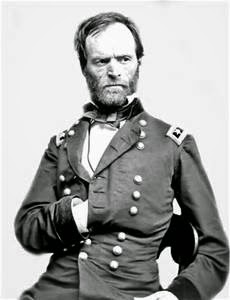
 General William T. Sherman
 

After a bumpy coach ride, General William Tecumseh Sherman, the commanding general of the entire U.S. Army, arrived at Fort Richardson just outside the frontier town of Jacksboro.  Named after a Union general killed at the Battle of Antietam, Fort Richardson was part of a Texas chain of forts established to protect settlers from Native Americans.  From here, U.S. cavalrymen patrolled the vast North Texas prairie for marauding Commanches and Kiowas.  Shortly after his arrival, Sherman began reflecting on the Indian problem and his doubts about its severity.  A number of settlers were complaining about Indian raids, but there was scant evidence that such raids were a regular occurrence.   After all, most of the Comanches and Kiowas were confined to a remote reservation - Fort Sill - located in the southwest corner of the Indian Territory.  Disease and war had reduced their numbers, and the depletion of the buffalo herds kept them dependent on government support.  All of Sherman’s doubts suddenly evaporated with the abrupt appearance of Thomas Brazeal, a teamster with Henry Warren’s supply wagons. 
By the early 1870’s, rampant corruption plagued the U.S. Commission on Indian Affairs.  President Ulysses S. Grant decided the Church could better handle matters with the Native Americans.  Since godly Christians were thought to be incorruptible, military officers were replaced with church officials to manage the Indian reservations.  When confronted by opposing congressmen, Grant replied, “Gentlemen, you have defeated my plan of Indian management; but you will not succeed in your purpose, for I will divide these appointments up among the religious churches, with which you dare not contend.”
The Society of Friends or “Quakers,” a society dedicated to nonviolence, was placed in charge of the most violent Native Americans in the United States.  The Quakers’ goal was simple - convert the nomadic, warrior Comanches and Kiowas into peaceful, sedentary farmers.  They appointed a balding Iowa farmer, Lawrence Tatum, to head the Kiowa-Comanche reservation at Fort Sill.  Considering their ancient warrior customs, converting Comanches and Kiowas into farmers would seem laughable at best.  No fool to Indian ways, Tatum certainly had his doubts.  In describing his new charges, the newly christened “Bald Headed Agent” wrote, “Those in the southwestern part of the territory were still addicted to raiding in Texas, stealing horses and mules, and sometimes committing other depredations, and especially this was the case with the Kiowas and Comanches.  They were probably the worst Indians east of the Rocky Mountains.”  Peaceful, though tough when he had to be, Tatum had the good sense to embrace Fort Sill’s troops in managing the reservation.  Nevertheless, the Kiowas were not about to hitch up a plow horse anytime soon.
Unlike the pragmatic Comanches, the Kiowas were a deeply spiritual people and were quick to rely on the prophecies of a charismatic medicine man or owl prophet.  Such was the case with an obscure Kiowa prophet named Maman-ti or “Skywalker.”  The prophet’s divinations entailed lengthy confinement to a lodge followed by chanting, praying and the unmistakable sound of flapping owl wings.  Afterwards, Maman-ti emerged with a compelling prophecy about the success or failure of an upcoming Kiowa raid.  Shortly after, raiding parties were assembled under the owl prophet’s personal command.  The problem for Tatum and the reservation staff - no one knew him personally or knew what he was up to.
Spring was the season for raiding and Maman-ti was working overtime.  He foresaw the success of a Kiowa attack on the white man’s wagon trains.  To supply its many forts with sustenance, the U.S. Army had to rely on plodding, mule driven wagons - there were no railroads.  Wagon trains, on the desolate prairie, were tempting targets.  Captain Henry Warren, a government freight contractor from Weatherford, supplied the forts of West Texas, including Fort Richardson.  On May 18, 1871, one of his wagon trains, laden with corn, was making its way up the Butterfield Trail toward Fort Richardson.  Several miles further up was a cavalry escorted ambulance with two high ranking passengers inside: General William T. Sherman and General Randolph Marcy, the U.S. Army’s Inspector General.  Both officers were inspecting Texas forts and Fort Richardson was on their list. 
Maman-ti planned his own tour of Texas - a brutal raid that included one hundred fifty Kiowa warriors.  Among the warriors were three of the Kiowa’s fiercest war chiefs: Satanta, Satank and Big Tree.  Satanta’s larger-than-life notoriety spanned decades among Native Americans and white men alike.   The party set out for North Texas and crossed the Red River between present day Vernon and Electra.  To lighten their load, the Kiowas stopped at a place they called “Skunk Headquarters,” a wooded patch with an unusual overabundance of skunks.  Nonessential belongings were dropped off to be guarded by a few young warriors they left behind.  Extra bridles were carried along for any horses they stole and some rode double in hopes of getting a new mount.   
Satanta
 
The Kiowas made their way to Salt Creek Prairie, an open field in Young County between Fort Belknap and Fort Richardson.  The area featured a sandstone hill with a tree-lined base overlooking the Butterfield Trail, an ideal spot for an ambush.  Unfortunately for Henry Warren’s teamsters, they would pass right by it.  During the evening before the Kiowas’ attack, Maman-ti went off alone to communicate with the spirits.  The flapping of owl wings was heard followed by the prophet’s return – he had a vision of two passing wagon parties. The first one was too small - not to be touched, but the second one would give them suitable plunder and scalps.  Sherman’s passing ambulance and cavalry escort would be that first party, thus costing the Kiowas a good chance of killing the highest ranking officer in the U.S. Army.  Warren’s wagon train was next. 
Dozens of whooping Kiowas galloped out of the woods toward the wagons.  Satanta, who learned how to play the bugle in his younger days, signaled the attack with a few crisp notes he borrowed from the U.S. Cavalry.  Like a Hollywood Western, the teamsters circled their wagons to hold off the attack.  Armed with repeating Spencer rifles, the teamsters were able to hold off the Kiowas but eventually fell to their superior numbers.  Seven teamsters were killed, while five, including Thomas Brazeal, managed to escape.  One teamster, Samuel Elliott, was tied to a wagon tongue and slow roasted over an open fire.  The rest were scalped and mutilated.  The Kiowas took forty mules back with them to the Indian Territory.
After Brazeal’s horrifying recollection, Sherman dispatched the 4th U.S. Cavalry to the massacre site. Under one the army’s most effective Indian fighters, Colonel Ranald Mackenzie, the troopers found Indian weapons scattered about the massacre site.  Their design left little doubt as to who was responsible. Sherman’s opinion about the Indian raids changed dramatically.  “I do think the people of Texas have a right to complain,” he wrote, “only their complaints are now against troops who are powerless, but should be against the Department of the Interior’s Bureau of Indian Affairs that feeds and harbors these Indians when their hands are yet red with blood.”  He set off for Fort Sill and a showdown with the Kiowas. 
Sherman arrived at Fort Sill on May 23 and asked an exasperated Tatum about any Indians off the reservation at the time of the massacre.  “The Kiowas and Comanches were completely out of control,” he replied.  “They come and go as they please.”  Surprisingly, the Kiowas were more apt to boast about the raid rather than try to cover their tracks.  Satanta bragged openly that he had led the raid.  With Sherman looking on, Satanta, Satank and Big Tree were arrested and placed in chains.  Maman-ti completely avoided arrest.
The three Kiowa chiefs were placed in a wagon and taken back to Jacksboro for trial.  Along the way, the elderly, melancholy Satank, who carried his dead son’s bones with him in a bag, attempted to stab a guard with a concealed knife.  The old chief was shot dead and his body was dumped unceremoniously off to the side of the road.  Having little regard for their Kiowa prisoners, Satanta and Big Tree were staked to the ground at night while their guards made camp.  
Satanta and Big Tree were sentenced to hang by Jack County Judge Charles Soward.  In an overly agitated state, he ordered Satanta be “hanged until he is dead, dead, dead and God have mercy on his soul.”  Hanging was a form of execution that horrified Native Americans. They feared the tightened rope would block the spirit’s passage after death.  To prevent a Kiowa uprising over the hangings, the sentences were commuted to life imprisonment.  The Kiowa chiefs served two years on a prison chain gang at Huntsville.  In the interest of peace they were paroled in 1874 and returned to Fort Sill. 
Before the end of the decade, continuing Comanche raids led to a military campaign (the Red River War) to force the remaining southern plains Indians on to reservations. The peaceful touch of the Quakers gave way to the clenched fist of the U.S. Army.  Satanta was arrested again for parole violation but he could never adjust to prison life; he took a suicidal leap through a prison hospital window at Huntsville. He was buried in the prison cemetery until he was reburied decades later at Fort Sill.  Big Tree renounced his warrior ways and converted to Christianity.  He became a leading citizen of Anadarko, Oklahoma and a deacon in the Baptist Church.  Maman-ti was taken prisoner during the Red River War and shipped off to Fort Marion in St. Augustine, Florida.  Fort Marion was an old British built fort used to imprison the more troublesome Native Americans.  Among it inmates was the celebrated Apache war chief, Geronimo.  It was there, the owl prophet died from the effects of dysentery.
The terrifying Kiowa warrior “Blue Duck,” in Larry McMurtry’s acclaimed book “Lonesome Dove” is based on Satanta.


Monday, January 5, 2015

Tatooed Mound Builders

Caddo Village


Today most people think of Native Americans as nomadic buffalo hunters.  Uncivilized types that resided in tepees, attacked wagon trains, and smoked long wooden pipes.  The Caddo Nation shatters this stereotype with well established villages, decorative pottery and a remarkable system of agriculture.    

The Caddo Nation was actually a confederacy of tribes that inhabited portions of Texas, Louisiana, Oklahoma and Arkansas. The three main tribes were: the Kadohadacho (good luck with the pronunciation) who lived along the Red River near the Oklahoma and Arkansas border, the Hasinai in East Texas, and the Natchitoches in Northern Louisiana.  The bountiful forests in the region provided them with fertile soil, abundant game, and wood for roomy, durable huts. The huts were roomy conical affairs that were built by fellow tribe members – similar to an old fashioned barn raising.  Archeological and linguistic evidence suggests the Caddo were once a mighty single tribe that migrated from the Caribbean Islands.  Like the Aztecs and Mayans, they had sizeable communities which featured a prominent, earthen mound that was likely used for religious ceremonies.  Before the 1800’s, the Caddo fell into decline and broke apart into a number of smaller tribes with a common language.  From that language, the name "Texas" was derived.  It was from the Caddo word for allies, "teyshas."

Caddo House
 
The main characteristic, that set them apart from other Texas tribes, was their farming skills.  Using crude tools made of stone and wood, the Caddo grew corn, beans, squash, and tobacco.   Unlike the Plains Indians, meat was only a small part of their diet.  Both men and women shared in the tasks of maintaining their gardens.  Abundant crops were produced to feed the tribe and get them through the winter months.

 In appearance, they supported elaborate tattoos made by inserting charcoal into their skin.  Males shaved their heads with only a single, long strip running down the middle.  The women painted themselves a variety of colors from the waist up.  At birth, Caddo infants had their heads pressed against boards, giving them a distinct cone shaped head as they grew older.

Like other Native Americans, the Caddo saw warfare as a sport, but with a spirited, week-long preparation period that involved feasting, dancing and praying.  A special house was constructed for this preparation period – a period that grew more intense with each passing day.  Finally, in a blind rage, the warriors burned the house down before setting off on their attack (sort of like your basic fraternity party).  Their primary weapon was the bow and arrow.  The bow itself was made from fine bois d’arc wood.  Because of its durability, the Caddo bow became a much sought after item at the local trading post.

Because of their proximity to the mouth of the Mississippi River, it was only a matter of time before they came into contact with the two great European powers in the region – France and Spain.  The Spaniards tried to establish missions among the Caddo but with no success.  The French had better luck with trading posts. Before their trade with the Caddo could expand, the French sold their Louisiana holdings to the Spanish, bought them back, and then sold them again to the United States.   

After contact with French traders and Spanish missionaries, disease began to decimate the Caddo. To make matters worse, their long time enemies, the Osage, began to seize their territory and force them out.  By the time Anglo pioneers began moving west, their numbers were significantly reduced - they became a mere footnote in U.S. frontier history.  During the mid 1800’s, their remaining numbers were forced on to reservations in Oklahoma.  Today the Caddo Nation is federally recognized and headquartered in Binger, Oklahoma.   

Sunday, November 16, 2014

The Horse Marines

General John B. Magruder


Colonel Tom Green ordered his command to form a single line during a frosty December morning. “I want three hundred volunteers who are willing to die for Texas, and are ready to die now,” he thundered. The entire 5th Texas Cavalry Regiment volunteered by taking a step forward; the three hundred would have to be chosen by their officers. Their assignment, however, would not be carried out on the back of a horse, but on the deck of a converted steamboat.

Since October 1862, a Union flotilla, under Commander Charles Renshaw, occupied the port of Galveston while the 42nd Massachusetts Infantry Regiment occupied its streets. Lacking sufficient numbers to fully occupy the city, the 42nd bivouacked at the end of Kuhn’s Wharf at night and patrolled the streets during the day. Though dangerously isolated, with little room to maneuver, the flotilla’s heavy guns defended the wharf from any infantry assaults. The commander of the 42nd Massachusetts, Colonel Isaac Burrell, was assured his men could be evacuated in a few minutes if it became necessary.

Confederate General John B. Magruder, Commander of the Texas District, wanted to retake Galveston. Referred to as “Prince John” by his fellow officers for his extravagant lifestyle, Magruder gained early acclaim for his deceptive tactics at the Battle of Yorktown. So effective were Magruder’s theatrics that Union General George McClellan was convinced he was heavily outnumbered - he actually had more than a two to one advantage. As a result, the Union advance was delayed, buying precious time for Confederate forces to establish a defensive front on the outskirts of Richmond, the Confederate capital. Magruder’s fame took a hit after a badly coordinated attack on Malvern Hill. The enormous losses led to a major shakeup of General Robert E. Lee’s command. Now a scapegoat, Magruder was transferred to far away Texas.

Texans considered Magruder a fighter and welcomed him with a downtown parade in Houston. Colonel John S. “Rip” Ford declared Magruder’s arrival was worth the addition of 50,000 troops. Bolstered by the local support, he immediately sought troops to recapture Galveston. Donning civilian clothes, Magruder crossed over to Galveston Island at night for a firsthand look at Union activity. Based on his own observations and those of the island’s residents, he formulated his plan of attack. The problem was where find the troops to carry it out.

Manpower was low to nonexistent on the Texas home front, but not entirely unavailable. Worn but rested after a disastrous campaign in New Mexico, the 5th and 7th Texas cavalry regiments were about to be dispatched to Louisiana. Instead, Magruder rerouted them to Houston. Now he needed a navy.

Transplanted New Englander, “Commodore” Leon Smith, appropriated a pair of side-wheel steamers – the Bayou City and Neptune. Each was to be equipped with one to two heavy cannons and 150 sharpshooters. Ragged in appearance as well as discipline, the Texans were anxious to redeem themselves with a victory on Texas soil or water for that matter. Colonel Green requested command of the sharpshooters while Smith would command the cottonclads. To protect the sharpshooters, cotton bales were piled like sandbags along the decks. For an onboard assault, two makeshift gangplanks were mounted to be dropped after steaming into a Union gunboat. 

On New Year’s Eve 1862, Magruder assembled his land forces at Virginia Point. A railroad bridge was planked over to allow his command to cross over to Galveston. Because of the mules’ refusal to cross the narrow bridge, the artillery and wagons had to be pulled over by hand. After the Texans took up positions near Kuhn’s Wharf, Magruder himself fired a canon to signal the attack. “Now boys, I have done my best as a private, I will go and attend to that of General,” he declared. The Texans attempted to assault the wharf with ladders carried out into the harbor and placed on the deck above – they were too short. Naval gunfire prevented a direct frontal assault across the wharf’s deck. Magruder’s infantry fell back to barricaded positions in town. The outcome now depended on Leon Smith’s cottonclads.

Magruder’s plan called for the cottonclads to attack after the assault on Kuhn’s Wharf got underway. It was hoped the assault would divert the Union flotilla away from Smith’s tiny fleet. A lookout on the Bayou City spotted the muzzle flashes and heard the intense gunfire – Smith ordered the cottonclads to attack. Their target was the revenue cutter U.S.S. Harriet Lane, a state of the art steamer used to pursue smugglers before the war. The Neptune stuck first by ramming into the Harriet Lane’s side. In the process, she suffered extensive damage to her bow followed by a canon shot from the Lane that caused her to sink. The fast thinking skipper headed the Neptune toward the nearby shallows. The onboard sharpshooters kept up an effective fire from the upper deck while the hull became submerged.

The Bayou City had better luck. The sharpshooters forced the Harriet Lane’s crew away from their guns and enabled the Bayou City to ram into the Lane. Green’s rebel-yelling marines poured out like ants onto the deck and overwhelmed the crew. The U.S.S. Owasco tried to help but couldn’t fire for fear of hitting their captured friends. The Lane’s colors were lowered and replaced with a white surrender flag. Smith boldly issued a demand for the surrender of the entire Union Flotilla.

Meanwhile, Commander Renshaw’s flagship, the U.S.S. Westfield, had ingloriously run aground during the battle and could not free herself. The captain of the U.S.S. Clifton, Captain Richard Law, rowed over on a small boat to the grounded Westfield. He told Renshaw about the Harriet Lane’s capture and Smith’s surrender demand. Law was afraid the captured guns on the Lane would be used on the flotilla. Not wishing the Westfield to be captured intact, Renshaw decided to blow up his flagship. After setting a fuse to the Westfield’s powder magazine, soaking the decks with flammable turpentine, and evacuating his crew to a nearby transport, Renshaw struck a match. The fuse proved defective when the Westfield blew up with Renshaw still onboard. Unsure of what to do next, Captain Law ordered the Union flotilla to steam back to New Orleans, leaving the 42nd Massachusetts and the Harriet Lane behind. Colonel Burrell surrendered his sword to General Richard Scurry, the commander of the infantry that attacked Kuhn’s Wharf. “Keep your sword colonel, a man who has done what you have deserves to wear it,” replied Scurry.

Despite all efforts to block or capture its harbor, Galveston remained in Confederate hands until the end of the war. Former Texas Governor and staunch Unionist, Sam Houston, penned a note of thanks to Magruder. “Thank you for driving from our soil a ruthless enemy. You have breathed new life into everything.” Further glory awaited Colonel Green in Louisiana, where his cavalry inflicted a string of humiliations on Union troops. His life ended tragically in 1864 at Blair’s Landing. While his troops sniped at Union naval vessels on the Red River, an ironclad’s lucky shot hit Green square on the head.


Four Dead in Five Seconds

Marshal Dallas Stoudenmire


Far from Austin, El Paso was a town destined for lawlessness.  Between El Paso and Austin were six hundred miles of arid desert, rocky escarpments, soaring temperatures, rattlesnakes, and Comanches.  Fort Sill, the nearby U.S. Army post, protected residents from the Indians but not the vices brought in by the new railroads.  Like many western boomtowns, El Paso had more than its fair share of saloons, gambling halls and whore houses.  Arguments were often settled with fists and pistols instead of a presiding judge.  Since there was no city government, the local saloon served as a combination courthouse, land office, post office, and city hall.  As a result, the saloonkeeper became a power broker of sorts; he could shape local politics and help appoint friends to high places.
In 1873, El Paso was incorporated and elected its first mayor, a popular saloon owner named Ben Dowell.  Affectionately called "Uncle Ben" by the locals, Dowell was a staunch Secessionist and flew the Confederate flag from his saloon's rooftop; the first one to fly over El Paso.  He was forced to leave town when Union troops occupied El Paso, but later returned after the war.  After Dowell's death, the Manning brothers (Jim, Frank, and Felix "Doc") continued Dowell's business and opened other saloons as well.  The largest of their enterprises was the "Coliseum," a combination saloon and variety theater complete with flirtatious show girls used to solicit drinks.
A close friend of the Manning brothers was the town marshal, George Campbell.  He had the connections, but not the competency for such a role.  His assistant, Bill Johnson, was more suitable for the role of town drunk.  Campbell was the fifth marshal in eight months. His replacement would usher in a new era of law and order for Old El Paso.
Dallas Stoudenmire was a six-foot-two, 185 pound mass of attitude with the rare advantage of having two steady gun hands and two holsters to draw from.  His height made him a big target during the Civil War; he was wounded several times while serving in the 45th Alabama Infantry.  Two bullets would remain inside him for the rest of his life.  Stoudenmire later served three years as a Texas Ranger before becoming El Paso's new marshal.
On his first day, the new marshal revealed his short temper when he stopped by the city jail to get the keys from Bill Johnson.  The former deputy was too drunk to produce them on demand.  Stoudenmire grabbed Johnson by the ankles and held him upside down.  The keys were produced after a vigorous shaking that no doubt left Johnson dizzier than he was before the new marshal arrived.
Border ranches in the 1880's often restocked their herds at the expense of  Mexican ranches across the river.  Rustling was a quick way to get a lot of cattle without the hassle of round ups and negotiated payments.   The problem, however, was the response from the Mexican ranches;  seventy five heavily armed vaqueros rode into El Paso looking for two of their missing comrades and thirty rustled cattle.  The bodies of the missing Mexicans were found near the ranch of Johnny Hale, a well known rancher and cattle rustler.  The two had been looking for the rustled cattle and stumbled upon two of Hale's ranch hands herding them into his pasture.  County Constable Gus Krempkau arrested the ranch hands for murder.  Tensions rose among El Paso's white Americans who didn't like armed Mexicans crossing the border and the Hispanic residents who demanded immediate justice.  Fluent in Spanish, as well as English, Krempkau soothed tempers while a court of inquiry was held and the arrests were made.  The Mexican posse returned home to bury their two friends.  Unfortunately, matters didn't end there.
On the following day, April 14, 1881, Constable Krempkau entered an El Paso saloon to retrieve his rifle and pistol left there the night before.  Johnny Hale and George Campbell followed him in and confronted him over the arrests of Hale's ranch hands.  An intoxicated Hale grabbed one of Campbell's holstered pistols and shot Krempkau.  Campbell and Hale left through the front entrance. 
The shot brought Marshal Stoudenmire up from his chair at the nearby Globe Restaurant.  With both guns drawn, he burst out of the Globe's front doors and began firing at Campbell and Hale.  An innocent bystander named Ochoa was accidently killed from the marshal's fusillade.  Upon looking out from behind an adobe pillar, Hale was killed instantly by a bullet to the forehead.  Before dying, Krempkau managed to shoot Campbell in the wrist and foot.  Stoudenmire finished Campbell off with a shot to the stomach.  The brief but bloody gunfight would pass into legend as the "Four Dead in Five Seconds Gunfight."
Despite the accidental shooting of Ochoa, a coroner's jury found Stoudenmire innocent in the performance of his duties.  Three days later, Campbell's drunken sidekick, Bill Johnson, tried to ambush Stoudenmire as he made his evening rounds.  Fortified with whiskey, Johnson emerged from behind a brick pile bearing a shotgun.  He stumbled backwards and fired both rounds over the head of the marshal; who in turn drew both pistols and dispatched Johnson with a shot to the groin.
Each killing padded Stoudenmire's  growing reputation and made him a living legend.  El Paso's crime rate plummeted as word got around about his ill-tempered  gun hands.  Nevertheless, living legends often become living targets.  The powerful Manning Brothers, close friends and business associates of Hale, Johnson, and Campbell, had it in for him.  The following February brought things to a head.
Like his brother-in-law, Marshal Stoudenmire, restaurant proprietor Samuel "Doc" Cummings, had a consuming dislike of the Mannings and told everyone within earshot that Jim Manning needed to be killed.  During a night of heavy drinking, Cummings spotted Manning and invited him into the Coliseum for a drink, while in the same breath, telling him what a sorry, no count individual he was.  Like most western gunfights, alcohol induced tempers played a major role in what followed.   Pistols were drawn and Cummings was shot dead by Manning and one of the saloon employees.  Because of their overwhelming influence, no El Paso jury would convict a Manning;  Jim Manning was not even charged with Cummings' murder.
A  factional dispute between Stoudenmire supporters and Manning supporters emerged as a result.  To avoid open warfare, the two factions agreed to a truce published in a local newspaper.  Signed by Stoudenmire, the Manning brothers and four witnesses, the truce stated that the two sides would "hereby agree  that we will hereafter meet and pass each other on friendly terms, and that bygones shall be bygones, and that we shall never allude in the future to any past animosities that have existed between us."  The truce was as laughable as it was brief.  Stoudenmire couldn't shake off the death of his brother-in-law; he began to drink heavily and hurl invectives at the Mannings.
On May 29, 1882, Stoudenmire resigned then was immediately appointed U.S. deputy marshal for the Western District of Texas.  His temper and drinking grew worse each passing day; local residents were too afraid to approach him.  The Mannings were smart enough not to directly confront him after he challenged them to a gunfight right outside their saloon.  On September 18, 1882, "Doc" and Jim Manning attempted to call a second truce with the marshal in a neutral spot - a saloon not owned by them.  It didn't work.  After a heated argument, gunfire broke out between both sides.  Stoudenmire was killed by a shot to the head. 
As with the shooting of Samuel Cummings, the Mannings were acquitted by an El Paso jury for the murder of Stoudenmire.  His wife, Isabella, had his body shipped east to Columbus, Texas and buried at Alleyton Cemetery in Colorado County.  Despite his quick temper and drunken tirades, Dallas Stoudenmire is often credited with taming the streets of El Paso.