home about resources filmscamp johnny reb Rebel Med
Showing posts with label Native American. Show all posts

Monday, January 5, 2015

Tatooed Mound Builders

Caddo Village


Today most people think of Native Americans as nomadic buffalo hunters.  Uncivilized types that resided in tepees, attacked wagon trains, and smoked long wooden pipes.  The Caddo Nation shatters this stereotype with well established villages, decorative pottery and a remarkable system of agriculture.    

The Caddo Nation was actually a confederacy of tribes that inhabited portions of Texas, Louisiana, Oklahoma and Arkansas. The three main tribes were: the Kadohadacho (good luck with the pronunciation) who lived along the Red River near the Oklahoma and Arkansas border, the Hasinai in East Texas, and the Natchitoches in Northern Louisiana.  The bountiful forests in the region provided them with fertile soil, abundant game, and wood for roomy, durable huts. The huts were roomy conical affairs that were built by fellow tribe members – similar to an old fashioned barn raising.  Archeological and linguistic evidence suggests the Caddo were once a mighty single tribe that migrated from the Caribbean Islands.  Like the Aztecs and Mayans, they had sizeable communities which featured a prominent, earthen mound that was likely used for religious ceremonies.  Before the 1800’s, the Caddo fell into decline and broke apart into a number of smaller tribes with a common language.  From that language, the name "Texas" was derived.  It was from the Caddo word for allies, "teyshas."

Caddo House
 
The main characteristic, that set them apart from other Texas tribes, was their farming skills.  Using crude tools made of stone and wood, the Caddo grew corn, beans, squash, and tobacco.   Unlike the Plains Indians, meat was only a small part of their diet.  Both men and women shared in the tasks of maintaining their gardens.  Abundant crops were produced to feed the tribe and get them through the winter months.

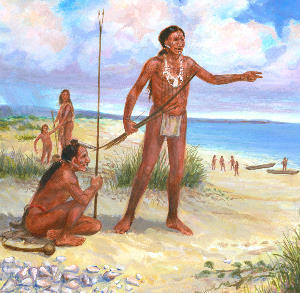
 In appearance, they supported elaborate tattoos made by inserting charcoal into their skin.  Males shaved their heads with only a single, long strip running down the middle.  The women painted themselves a variety of colors from the waist up.  At birth, Caddo infants had their heads pressed against boards, giving them a distinct cone shaped head as they grew older.

Like other Native Americans, the Caddo saw warfare as a sport, but with a spirited, week-long preparation period that involved feasting, dancing and praying.  A special house was constructed for this preparation period – a period that grew more intense with each passing day.  Finally, in a blind rage, the warriors burned the house down before setting off on their attack (sort of like your basic fraternity party).  Their primary weapon was the bow and arrow.  The bow itself was made from fine bois d’arc wood.  Because of its durability, the Caddo bow became a much sought after item at the local trading post.

Because of their proximity to the mouth of the Mississippi River, it was only a matter of time before they came into contact with the two great European powers in the region – France and Spain.  The Spaniards tried to establish missions among the Caddo but with no success.  The French had better luck with trading posts. Before their trade with the Caddo could expand, the French sold their Louisiana holdings to the Spanish, bought them back, and then sold them again to the United States.   

After contact with French traders and Spanish missionaries, disease began to decimate the Caddo. To make matters worse, their long time enemies, the Osage, began to seize their territory and force them out.  By the time Anglo pioneers began moving west, their numbers were significantly reduced - they became a mere footnote in U.S. frontier history.  During the mid 1800’s, their remaining numbers were forced on to reservations in Oklahoma.  Today the Caddo Nation is federally recognized and headquartered in Binger, Oklahoma.   

Monday, May 5, 2014

Comanche Rising


They subjugated the Aztecs. They massacred the Incas.  Gold and precious stones flowed like tap water into Spanish coffers.  The New World, it seemed, was easy pickings for the mighty Spanish Conquistadors.  Superior firearms, along with superior European tactics, could overcome any tribe of godless savages. 

So they thought.

Since the late 1600's, the Comanches dominated West Texas.  Superior horsemanship gave them an unprecedented advantage over their adversaries.  Fearing the Comanches growing dominance, the Lipan Apaches of South Central Texas needed a powerful ally.  The Spaniards were their best prospect.  In 1757, Franciscan monks established the Mission Santa Cruz de San Saba near present day Menard, Texas.  Having expressed an interest in Christianity, the Apaches convinced the missionaries that they wanted to become peaceful civilized Catholics.  The missionaries were also anxious to establish a mission to help end a bitter conflict between the Apaches and foster mining operations near the San Saba River. What the missionaries failed to realize, however, was that they were being played.  The Apaches never took up residence near the mission nor attended services.  To make matters worse, they bragged about their powerful new ally;  Conquistadors armed with canons, swords and muskets.  Rather than instilling fear into the Comanches, the Apaches only ticked them off.

Along with their well armed neighbors, the Wichitas, the Comanches assembled a force of 2,000  warriors on horseback then rode out looking for the Apaches.  They descended on the Santa Cruz mission and massacred the monks, including their leader Father Alonso Giraldo de Terreros.  Those that survived were barricaded in a nearby presidio (or fort)  commanded by Colonel Ortiz Parrilla.  Father Terreros had purposely built the presidio away from the mission in hopes of not provoking the Indians.

In September 1759,  Colonel Parrilla gathered a force of 600 Spaniards and Apaches to pursue the Comanches.  Little did he know that the Comanches were as well-armed, if not better armed, than his command.  Redoubtable as traders as well as warriors, the Comanches had a lucrative relationship with French traders along the Red River.  Muskets were obtained in exchange for horses which they had plenty of.  The French also provided military assistance with advice on defensive works, something Comanches are not generally known for.

At Spanish Fort, in present day Montague County, Parrilla encountered a stout earthen fortress of entrenched Indians and possibly a few French.  The canons had no effect on the fortress while the Comanches flanked the Spaniards with mounted attacks.  Parrilla was forced to fall back, leaving behind nineteen or more dead.  It was to be the Spaniards high water mark in Texas.  The Mission Santa Cruz de San Saba was the only mission in Texas to be completely destroyed by Native Americans.  Ten years later the presidio was closed.  The Spaniards were never able to settle in Comanche territory.

Friday, December 6, 2013

Forsaken Ally


 Members of Tonkawa Tribe
 
 
Whenever the early Texas settlers needed a good, stand up ally, they could find one in the Tonkawa Nation.  Of all the Native American tribes in Texas,  the Tonkawa were always quick to offer assistance to their Anglo neighbors.  Stephen F. Austin developed cordial relations with them and welcomed them into his colony.  At every social affair held by the settlers,  members of the Tonkawa tribe would often show up uninvited.  Texas rangers used them as scouts and auxiliary troops against the Comanches. 

 For decades, the Tonkawa inhabited Central Texas near present day Austin.  Advancing pressure from the Comanches in the North and the Apaches to the West forced them to seek alliances with any group that could help fend them off.  The Anglo settlements offered them a powerful deterrent against their long time enemies.   It's not surprising they were friendly towards them. 

The Tonkawa adopted the customs of the Plains Indians with its emphasis on the horse and buffalo hunt.  Tonkawa families lived in crude tepees within a maternal clan.  They wore little or no clothing; the men wore excessively large breechcloths and the women donned short skirts and painted breasts.  During the winter, they wore buffalo robes.  The Tonkawa  had a preference for facial ornaments such as earrings, necklaces and tattoos.  Subsistence came from anything they could hunt or gather.  This included, buffalo, deer, jackrabbits, pecans, oysters, crayfish, and dogs.  Pecans were used as a form of barter.  Farming was tried but with little success.    

The Tonkawa had one abhorrent custom: cannibalism.  Like the Karankawas, the Tonkawa didn't consume human flesh for food, but as a ritualistic means of acquiring a dead persons spirit and strength.  During a "Scalp Dance," they bit off portions from the cooked limbs of a slain enemy.  The Comanches, along with the other neighboring tribes, greatly detested this practice, especially when members of their own tribe were consumed. 

The period of close relations with the settlers came to an end in the 1850's.  The Tonkawa were forced on to a reservation in Young County near the Brazos River.  Because of the incessant Comanche raids on their settlements, Texans began to regard all Native Americans  as hostile.  In some cases, Tonkawa villages were attacked by angry settlers who wanted them removed.  Before the start of the Civil War, the Tonkawa were moved across the Red River into the Indian Territory (now present day Oklahoma). 

During the war, the Tonkawa continued to serve as scouts for the Texas rangers  and backed the Confederate authorities that managed their reservation.  The other tribes hated the Tonkawa for helping the Texans and their continued practice of cannibalism.  On October 23, 1862, a coalition of the Osage, Shawnee, Kiowa, Caddo and Comanche tribes attacked the Tonkawa's  Wichita Agency near present day Fort Sill.  The Confederate agent, Mathew Leeper,  escaped out a back window in his nightshirt while his agency was burned to the ground.  The Tonkawa were forced to flee but many were caught and killed on the spot.  Their long time leader, Chief Placido, was slain along with 137 men, women and children.  Already decimated from disease, the Tonkawa were almost wiped out . 

The survivors fled back to Texas near Fort Belknap.  Like today's homeless people, they lived in squalor near Fort Griffin until the late 1880's.  They were later moved to the Sac and Fox agency in Oklahoma.  Because of their dwindling numbers, the Tonkawa language was lost along with many of their songs and dances.  Today, the tribe has only 600 members that reside in Oklahoma.


 Tonkawa Scouts and U.S. Cavalrymen
 

Sunday, June 17, 2012

The Light Gray Apaches


Life in Utopia, Texas was not always like the town’s name. This remote Hill Country community was far from the long established towns in East Texas, an easy target for outlaws and Indian war parties.   Thirteen year old Frank Buckelew knew something about war parties.  In 1866, his father was killed by a war party two miles from his home.  Now orphaned, Frank and his two sisters moved in with their uncle.  While out in the pasture tending to his uncle’s oxen, he and his friend Morris were startled by two steers racing by; something had spooked them.  Deciding speed was the better part of curiosity, he and Morris took off for his uncle’s house.  A band of Indians emerged from the nearby woods and gave chase.  Morris got away, but Frank didn’t.  A warrior caught up with Frank and held a drawn bow and arrow to his head.  The war party roughly subdued their captive and took him to their village.  Frank’s youth probably saved him from an imminent death.  It didn’t save him from a severe beating.  Frank was stripped of his clothing then whipped with cat’s claw vines by the village’s children and women.  The worst of it came when he had to walk through a long gauntlet of taunts, clubs, leather whips, sticks, and punches.  Dazed and bruised, he was painted, dressed in Indian garb, and had his ears pierced by an elderly woman.  He was now an initiated member of the tribe.  A tribe referred to in history and today as the Lipan Apaches.   


The Lipan Apaches were part of an array of Apache tribes that extended from Arizona to Central Texas.  The word Lipan means “Light Gray People” because the Lipans believed each point of the compass was represented by a color. White represented north and black represented east.  Since the Lipans migrated from the North (white) to the East (black) the colors became mixed into light gray, hence the name Lipan. 


The Lipans belonged to the Eastern band of Apaches that consisted of the Jicarilla, Kiowa-Apache and Lipan Apache.  Attracted to the vast buffalo herds in the Southern Plains, they entered Texas in the 1600’s.   Despite the Lipans’ initial interest, Spanish missionaries tried to convert them, but to no avail.


 What the Lipans really wanted from the missions was protection from a shared enemy: the Comanches.  Masters of horse warfare, the Comanches were unstoppable in the 1700’S and early 1800’s.  They slowly pushed the Lipans into Mexico and Southwest Texas.  Because of their semi-sedentary lifestyle from raising crops, Lipan villages were isolated, tempting targets for the Comanches. It was little wonder Lipans served as scouts and auxiliary troops for the Texas Rangers.  One Lipan chief, Flacco, became a colonel in the Republic of Texas Army.


The Lipans lived in scattered bands that shared a common language and culture.  There was no tribal head chief, only the loosely held position of band chief.  Anyone could lead a raid or a hunt as long as he had the followers to carry it out.  In time, they gave up on raising crops and became more nomadic like their Plains Indian neighbors.  They took to the horse and hunted buffalo.  In addition to buffalo, their diet consisted of deer, antelope, the agave plant, and a coarse flour obtained from the Sotol bulb.  The astonishing thing about Apaches is how they could find sustenance in the most barren, desolate regions of the Southwest.  In the desert, they ruled!


Like most Plains Indians, they wore breech cloths during the summer and buckskin shirts in the winter.  Males shaved the left side of their heads while letting the right side grow to shoulder-length.  They tied their hair into braided ponytails and decorated them with feathers. Lipans lived in teepees and wikiups with a smoke hole at top for lighting fires inside.


 Marriages were carried out after a lengthy courtship with the prospective wife and her family.  The groom had to give a horse, weapons and deer skins as gifts for the daughter’s hand.  It’s sort of like buying your future in-laws a new pickup before you married their daughter.  Unless the daughter looked like Taylor Swift, I doubt many young men today would go for that.  Also, once you married into that family, you were obligated to provide for that family until they released you, even if your wife died.  In that case, you had to marry a sister or cousin.  If the husband died, the wife would shave off her hair, wound herself, and weep for days on end.  I doubt my wife would shave her head upon my demise.  She would just plant me and throw away my underwear.


Apaches of all bands had a morbid fear of ghosts.  When someone in the village died, the elderly had to prepare it for burial so the young folks wouldn’t be contaminated by the dead person’s spirit.  Along with their personal possessions, the corpse was carried on its horse to the burial site.  Upon arrival, it was buried with its possessions and the horse was killed over the gravesite.  After the burial, the relatives took an alternate route back to the village to confuse any newly risen ghosts that might follow them home.


Smallpox, Comanches and the U.S. Cavalry took a frightful toll.  The Mexican Army considered them a nuisance and went out of their way to eradicate them.  Texas settlers complained of Lipan raids from across the Mexican border.  In 1873, six companies of the 4th U.S. Cavalry attacked Lipan camps in Coahuila, Mexico.  Their chief, Costalites, was captured and taken to San Antonio.  He was imprisoned in a filthy corral serving as a prison camp but later escaped.  Costalites was found dead 13 miles from San Antonio.  Many of the remaining Lipans joined the Mescalero Apaches on their New Mexico reservation.  The few left in Texas, like most Texas tribes, were forcibly moved to Southwest Oklahoma.


White captives, like Frank, were usually given the task of caring for the horses.  He was also about to fall prey to an arranged marriage.  After a year, Frank decided he had enough and escaped.  He later became a Methodist preacher.  Frank Buckelew died in 1931.


For decades, it was thought the Lipans had disappeared, assimilated by other tribes and the general Hispanic population.  That changed as more and more Lipan descendants became aware and better informed of their ancestry.  In 2009, the Lipan Apaches became a state recognized tribe based in McAllen.  A rich culture brought back into the Texas fabric.

Saturday, November 12, 2011

What the Heck Happened to the Karankawas?

The Karankawa Indians | Karankawa | Scoop.it

If you travel extensively in New Mexico, Oklahoma, or Texas, chances are you will encounter a reservation, cultural center or hotel casino administered by Native Americans once indigenous to Texas.   One tribe will not be among them.  For decades, the Karankawas once flourished along the Texas coast from Galveston to Corpus Christi.  By the late 1800’s, they were extinct.
Most of what is known about them comes from the first person accounts of European explorers and missionaries.  The most vivid was from Cabeza de Vaca, a shipwrecked Spanish explorer who lived among them for several years.  He describes a handsome race of nomadic hunters and gatherers that subsisted on seafood during the summer and deer meat during the winter.  Unlike their Plains Indian neighbors, these Native Americans were a staggering 6 to 7 feet tall.  The Karankawas also tattooed their bodies, pierced their breasts and chins with a piece of cane, and traveled coastal waters in dugout canoes.  Their preferred weapon was an extremely long bow that was as tall as or taller than the person shooting it.  Karankawa homes were similar to today’s camping tents.  Made of willow poles and animal skins, they were called wickiups.  For insect repellent, the Karankawas covered themselves with alligator grease.  Based on the eyewitness accounts, the smell of that stuff could knock the ticks off a bird dog. 
The treatment of Karankawa wives was like the way you would treat a fishing rod.  As long as she worked and bore children, everything was fine; you kept her around.  You might even loan her out to your friends.  Otherwise, you could simply divorce her and find a new one.  There was also an in-law taboo where the wife’s parents could not have any contact whatsoever with the husband or enter his wickiup.  It seems the Karankawas had a leg up on the in-law situation, long before we started making jokes about it. 
The Karankawas had some really strange and horrifying ceremonies called “Mitotes.”  During the ceremony, a drink made from Yaupon leaves was consumed by male tribe members.  Called the “Black Drink,” it produced a jolt more powerful than day old coffee at a truck stop.  Some of the Mitotes involved a ritualistic form of cannibalism.  Victims (usually prisoners of war) were tied to a stake near a roaring campfire.  The Karankawas would dance around the fire while brandishing knives.  As they passed the victim, they sliced off a piece of flesh, toasted it like a marshmallow in the fire, and then consumed it before the victim.  By doing this, they believed they were absorbing their enemy’s strength.   Unfortunately, the Karankawas got a bad rep for this practice, a common one actually among Gulf Coast tribes.  Anglo settlers, who had little regard for Karankawa customs, just assumed they included people on their daily menus.
The beginning of the end probably came in 1685 with the arrival of French colonists.  Sponsored by a French explorer named La Salle, the colonists landed at Matagorda Bay and built a settlement at nearby Garcitas Creek.  Everything that could possibly go wrong in a European colony went wrong at La Salle’s colony. Their supply ship wrecked off the coast, sending most of their essentials to the bottom.  In six months, disease, malnutrition and exposure reduced the population from 180 to 90.  To make matters worse, the colonists lifted a couple of Karankawa canoes.  Not ones to shrug off impoliteness, the Karankawas responded by relentlessly attacking them.  Usually successful when it came to Indian relations, the French failed miserably with the Karankawas.  Taking advantage of the colony’s decline, the Karankawas wiped it off the map.  Only a couple of children were taken into captivity.
Not thrilled with a French colony in their neck of the woods, the Spaniards countered by setting up missions near the Karankawa’s territory.  Despite their best efforts, the Spanish missions failed to convert the Karankawas; they simply weren't buying it.

Bringing disease with them, European colonists and missionaries infected the Native Americans along the Texas Gulf Coast.  The Karankawas began dying off in droves.  Warfare with Texas settlers, other Native Americans (mostly the Comanches), Mexican ranchers, and Pirates hastened their demise.  Before the American Civil War began, the Karankawas disappeared, never to recover.  Only the efforts of archaeologists, anthropologists and historians keep their story alive. 

 The plight of the Karankawas was best summed up by anthropologist, Dr. W.W. Newcomb, Jr., in his book, "The Indians of Texas" (1961, University of Texas Press):

"Our civilization is like a great blanket cushioning and protecting us from the raw world; the Karankawas blanket was thin and patchy.  Yet, they survived, even thrived, and were happy with their ways.  To Europeans and Texans it was astonishing and insufferable that such a people should prefer their own gods, food , and customs to civilization's blessings.  But they did, and they clung to these ancestral ways.  And for this they perished.  To persevere to such ultimate tragedy is a highway to continuing remembrance."


On a lighter note, here is a “You Tube” trailer for the 1966 Western parody film, “Texas Across the River.” It features Hollywood’s favorite Karankawa played by "Rat Pack" comedian Joey Bishop. Named Kronk, Bishop sounds more like a Chinese tourist than a Native American out of his element.  This is one those movies that is so goofy, it’s funny. The Karankawas, however, didn’t don the buckskin attire worn by Kronk.  They wore breech clothes.  After all, they lived on the beach.  Considering the attire or lack of attire on beaches today, that's not surprising.
Believe it or not, a few beers and this movie can make for a fun evening.  Check out Joey Bishop’s rain dance; that’s why you need the beer.

Sunday, March 27, 2011

A Battle of Mistaken Identity

Kickapoo Wigwam


The signs were unmistakable.  An encampment of over one hundred wigwams and tents had been here.  Unlike the dreaded Comanches who traveled in small fleeting bands, the abandoned Indian camp had over five hundred inhabitants and left a trail one hundred yards wide.  Under the command of Captain N.W. Gillentine, twenty members of the Erath County Militia followed the trail until they discovered a freshly covered grave.  Curious about its contents, they unearthed the body of a young Indian girl dressed in full Native American costume and surrounded with various trinkets.  Some of Gillentine’s men jokingly referred to the corpse as “bad medicine” and they would all be cursed for disturbing the grave. Cursed or not they helped themselves to the trinkets and portions of the dead girl’s clothing.  The joking, however, would prove fortuitous.  Galletine and most of his men would be dead within a month.
What was thought to have been marauding Comanches were actually friendly Kickapoos out of the Kansas Pottawatomie Agency.   The Kickapoos were an Algonkian people that once inhabited present day Wisconsin.  A semi-nomadic tribe, they raised crops and hunted game from large established villages.  As white settlers moved closer to their land, the Kickapoos migrated to Kansas, Texas and the Indian Territory (now present day Oklahoma).  After the Texas Revolution, the new republic adopted a “zero tolerance” policy toward all Native Americans.  Most of them were forced on to reservations in the Indian Territory.  The Kickapoos headed south across the Rio Grande to Northern Mexico where their descendants remain to this day.
After the Civil War broke out, the Kansas Kickapoos were pressured to support the Union cause.  They were armed with Enfield rifles and participated in Union campaigns against their Confederate brethren in the Indian Territory.  In December 1864, the Kickapoos decided they had had enough of the white man’s war and would join their fellow Kickapoos in Mexico.  Nine hundred Kickapoos journeyed out into the vast West Texas frontier.  Their great numbers soon caught the attention of Confederate frontier units.  
Based on Captain Gillentine’s scouting report, Captain Henry Fossett and 161 members of the Confederate Frontier Militia set out from Ft. Chadbourne in pursuit of an unknown band of Native Americans.  Captain S.S. Totten followed 15 miles behind with 325 members of various county militias.  The Kickapoos were found encamped 20 miles southwest of San Angelo along the banks of Dove Creek.  No one bothered to communicate with them and find out their intentions.
The Kickapoo camp was heavily surrounded by a dense thicket which offered a ready-made defensive position.  They were armed with their Civil War Enfields which were superior to the Texans diverse collection of short ranged shotguns and pistols. In addition, the Texans would have to attack from the open prairie, thus giving the Kickapoos an unobstructed field of fire while safely concealed in the thicket.
Fossett and Totten fashioned a battle plan to bag the whole lot of them.  After his men waded the waist high, frigid Dove Creek, Totten would attack from the north.  While the Kickapoos were occupied with Totten, Fossett would attack from the south, capture the tribe’s 1,000 horses, and cut off any escape routes.  The attack would commence on the morning of January 3, 1865.
Totten’s command ran into immediate trouble when the Kickapoos began picking them apart with their long range Enfields, something the Texans hadn’t expected.  Totten fought bravely but had trouble targeting the Kickapoos within the heavily wooded thicket.  Captain Gillentine was fatally wounded.  After handing over his rifle to his companion, John Anderson, he proclaimed with a straight face, “John, I’m a dead man.” He died later that evening.  As Totten was forced to fall back, the Kickapoos worked their way toward Totten’s vulnerable flanks, pouring in a deadly enfilading fire.


Meanwhile, Fossett captured most of the Kickapoo horses and fought his way into the Kickapoos' camp.   For five hours, he held of Indian attacks but lost most of the horses.  Two hours after sunset, the battle ended after the Indians withdrew into the depths of the thicket.  Leaving their dead behind, the Kickapoos broke camp and continued their journey the next day.
The Texans fell back a few miles east to Spring Creek. Both sides suffered close to 50 dead and wounded.   At 10:00 PM that evening it began to snow, adding to the misery of the wounded.  Short of food, the Texans shot a few of the Indian ponies for meat.  The next morning, Totten returned to the battlefield and buried his dead.  The bodies were not scalped but stripped of their clothing by the Kickapoos. 
The Kickapoos reached their new home in Mexico but harbored intense bitterness after Dove Creek.  In addition to the persistent threat of Comanche raids, Texas now faced raids from vengeful Kickapoos.  A short sighted assumption that all Native Americans were enemies led to unnecessary deaths, grieving families, and more adversaries during a long civil war.