home about resources filmscamp johnny reb Rebel Med
Showing posts with label Old West. Show all posts

Tuesday, December 11, 2018

Hamer's Posse

Bonnie and Clyde


Few criminals have fired imaginations like Bonnie and Clyde.  A multitude of books, an academy award winning movie and a 1967 chart-topping song have told their story for over seventy years.  Often viewed as a romantic pair of Robin Hoods, their lives were anything but.  They were constantly on the dodge, lived out of stolen cars, and made little from their holdups.  Even worse, innocent people were killed.  As their notoriety grew, they were always recognized, forcing them to avoid family and friends for extended periods.  After a four year crime spree (1931-1934), it all came to a gruesome end, brought about by an unrelenting Texas Ranger. 

Clyde Barrow was born to a sharecropper family seeking a better way of life.   The Barrows settled in West Dallas, an extremely poor community during the Depression Era.  Homeless, the Barrows lived under their wagon until they could afford a more commodious abode - a tent.  With little work available, young men turned to crime instead.  Clyde started his life of crime while still a child, going from petty theft to robbery before he turned twenty.  A stint at the Eastham State Prison Farm, near Huntsville, stoked his criminal behavior rather than rehabilitate it.  The guards beat him unmercifully and one inmate named “Big Ed” raped him.  In a blind fury, Clyde dispatched Ed with a pipe, but was not charged for the murder.   Eager to get out of the grinding work details, he had a fellow prisoner chop off two of his toes with an ax.  Ironically, through the efforts of his mother, Clyde was paroled shortly after he lost his toes.  During a visit to a friend’s house in Dallas, he met the love of his violent life, Bonnie Parker.

Bonnie Parker also grew up in West Dallas.  Her family residence was in Cement City, a factory town dominated by a large cement factory that emitted clouds of choking gray dust.  Unlike her future boyfriend Clyde, Bonnie was a gentle soul who liked to write poetry.  She was lauded by her teachers for her good grades and sweet attitude.  Pretty and petite, it would seem Bonnie was destined for a better life.  The environs of West Dallas dictated otherwise.  Her dad, a bricklayer, died when she was young, leaving her mom destitute.  Bonnie had to wait tables to help her out.  At sixteen, she married a petty criminal, who abandoned her for long stretches while pursuing his profession.  Because of her own criminal life, she never got around to divorcing him.  Photos of Bonnie, found at a Barrow Gang hideout in Joplin, Missouri, shows her posing with a variety of firearms while smoking a cigar.  Bonnie was never that manly; she only smoked cigarettes.  Former gang members have stated she never fired a gun at the police.

Bonnie and Clyde were attracted to each other the moment they met.  She stayed with him throughout their four year spree.  Along with Clyde’s brother, Buck, and Buck’s wife, Blanch, they robbed a number of small town stores and gas stations, shooting those that got in their way.  When feasible, they robbed small town banks, though their take wasn’t much.  The Depression kept those banks to a very minimal cash reserve - $3,000 or less.  Before their demise, the Barrow Gang killed 12 men; most of them were in law enforcement.  They traveled as far north as Minnesota, with brief stops in Joplin and Platte City, Missouri.  At both places, they fled after shootouts with the local police.  Buck was killed from a gunshot wound to the head.  Blanche lost an eye and was captured.  Bonnie’s legs were severely burned when Clyde, ignoring a warning sign, drove their car off a riverbank.  Applications of sodium bicarbonate (baking soda) saved her legs and probably her life.

Under-budgeted police and sheriff departments couldn’t match Bonnie and Clyde’s firepower.   Clyde kept his gang well armed with automatic rifles stolen from state guard armories.  His favorite was the Browning automatic rifle, later used as a light machine gun during World War II. To make matters worse, they couldn’t give chase beyond their own jurisdictions, making it difficult to apprehend them.   Outgunned and outdistanced, a new approach was needed.  The impetus came from two events:  a daring prison breakout, engineered by Clyde, which freed several convicts from Eastham, and the deaths of two Grapevine patrol officers gunned down by Clyde.  Under mounting pressure from the public, Texas’ first female governor, Miriam “Ma” Ferguson, assigned Texas Ranger Frank Hamer the job of bringing down Bonnie and Clyde.

Frank Hamer was an old school ranger, more at home on the back of a horse than a police car seat.  As a city marshal, he cleaned up the Texas boomtown of Navasota.  The town was so violent; a hundred men had been gunned down on the main street within a year.  As a Texas Ranger, he took on bootleggers and the Klu Klux Klan, preventing 15 lynchings.  As his tough guy image grew, Hamer could clear the streets of an angry mob with one simple command - “Git !” 

 Frank Hammer

After his appointment, Hamer formed a detail of four hardened law enforcement veterans.  He knew that in order to catch the ever moving crime duo, you had to live like they did.  That entailed endless driving, camping outdoors, and long periods away from their homes, just like an Old West posse.  Hamer’s posse included Manny Gault, of the Texas Highway Patrol, Bob Alcon, of the Dallas County Sheriff’s Dept., and Ted Hinton, of the Dallas County Sheriff’s Department.  Hinton had grown up in West Dallas and knew the Barrow family.  Bob Alcorn had been waited on by Bonnie during her stints as a cafe waitress. After months on the road, they finally tracked Bonnie and Clyde to Bienville Parish, Louisiana, the home of one of their gang members, Henry Methvin.

Hamer noticed the crime duo followed a familiar pattern during their years of crime; they tended to stay close to county and state boundary lines.  By doing this, they could evade local law enforcement by simply crossing over jurisdiction lines.  In addition, they routinely stopped to visit their families and those of their gang members.  Hamer knew about the family visits and was informed in Shreveport that Bonnie and Clyde were due to visit the Methvin home at Gibsland, a remote town in Bienville Parish.  Hamer added Bienville Parish sheriff, Henderson Jordan, and his deputy, Prentiss Oakey, to his posse.  With the assistance of Henry Methvin’s father, Ivy, an ambush was set up along a road near the Methvin home.  Posse members disagree on whether or not a deal was made with Ivy - a lighter sentence for his son in return for his cooperation.  Nevertheless, Ivy’s truck was parked off the side of the road as bait for the ambush.  Thinking Ivy’s truck was broken down, Clyde would stop to help.  Hamer would then make his move.

On May 23, 1934, Bonnie and Clyde were driving a stolen Ford Sedan when they spotted Ivy’s truck.  Bonnie was eating a sandwich with a map on her lap.  Clyde was driving in his stocking feet with a shotgun between his legs.  They stopped.  From there, the accounts differ on what happened next.  Were Bonnie and Clyde told they were under arrest before the shooting began?  Tired of the chase and the government pressure, it would seem doubtful Hamer would leave anything to chance.  Considering the past gunfights Clyde was involved in, it was also doubtful he would have peacefully surrendered.  A hailstorm of bullets hit Clyde’s car.  Bonnie and Clyde were riddled from head to toe.  Bonnie’s nose and lower jaw were almost shot away, leaving her distorted mouth full of broken teeth.  What happened next was a festival of the grotesque.

Instead of using discretion, the bullet-riddled car, with Bonnie and Clyde still inside, was towed to a furniture store in Arcadia that doubled as a funeral home.  Because of the eight mile distance to Arcadia, a faulty tow truck, and overheard phone calls from Hamer to Texas law enforcement officials, word spread like wildfire about the ambush.  Morbidly curious, a mob gathered outside of the Conger Furniture Store.  At one point, the tow truck broke down in front of a Gibsland elementary school.  School children ran out to view the car and its ghastly contents.  Needless to say, they recoiled in horror.  One of the students fainted.  It only grew worse from there; a tightly packed crowd surrounded the car when it reached the furniture store.  Beer and sandwiches were sold at inflated prices to the crowd.  Ladies dipped their handkerchiefs in the blood, bits of bloody hair were snipped from the corpses, and one man tried to cut off one of Clyde’s ears while another tried to saw off a finger.  Laid out inside the store's mortuary, the bodies were almost too riddled to be embalmed.  Bonnie and Clyde were laid to rest at separate cemeteries in Dallas.  Clyde Barrow’s funeral was one of the largest attended in Dallas history.  At the time of their deaths, Bonnie was only twenty-three years old.  Clyde was twenty-five.


After the deaths of Bonnie and Clyde, Hamer, along with twenty rangers, prevented sabotage during the 1935 Gulf Coast longshoremen’s strike.  Next to the Bonnie and Clyde ambush, Hamer’s most controversial role came when he accompanied Governor Coke Stevenson, who had just lost a tight Congressional race, to Alice, Texas in the notoriously corrupt Jim Wells County.  Hamer told an armed crowd of locals to get lost while the tally seats were examined for fraud, especially the votes from a mysterious Precinct 13 ballot box.  Although the box was stuffed with over three hundred nonexistent voters, Stephenson’s opponent still won the election.  The opponent was Lyndon B. Johnson.  Hamer died on July 10, 1955 from the effects of a stroke two years earlier.  He was buried near his son, who was killed at Iwo Jima, at Memorial Park Cemetery in Austin.

Sunday, June 18, 2017

Walker

Samuel Walker


It seemed like an unlikely pairing: a well-heeled Connecticut gunmaker and a rough hewn Texas Ranger.  Despite their backgrounds, both had an abiding passion for firearms, and how to improve them.  They met at a New York gunsmith shop to exchange their ideas.  The result was a revolving pistol that would change the course of Texas and the American West.
Fighting Mexicans and Comanches provided Texas Rangers with more than a firsthand knowledge of firearms.  Being on horseback, it was crucial they have repeating firepower to take out mounted, hard charging adversaries.  This needed feature became apparent in confrontations with the Comanches.  The “Lords of the Plains” could use a bow and arrow faster than Rangers could fire and reload a musket.  To make matters worse, the Rangers often had to get off their horses to fire at them; the Comanches could stay on horseback.  The solution came from an unlikely source: the Texas Navy.  In 1839, the Texas Navy purchased 130 of Samuel Colt’s revolving pistols.  Named for their origin of manufacture, Patterson, New Jersey, the Patterson Colt featured a five shot cylinder with .36 caliber paper charges.  Though fragile with its delicate frame, pocket watch mechanisms and cumbersome reload process, the Colts provided game changing firepower.  Better yet, they could be fired on horseback.  When Republic of Texas President Sam Houston disbanded the navy, a surplus of Texas Navy Colt revolvers became available.  The Rangers helped themselves.

On June 8, 1844, the Patterson Colts got a thorough shakedown.  At the battle of Walker’s Creek, fifty miles north of San Antonio, a Ranger detachment of 14 battled 70 Comanches under Yellow Wolf.   When numbers were starting to tip the balance in the Comanches favor, Captain Jack “Coffee” Hayes shouted, “Any man who has a load, kill that chief!”  Yellow Wolf was dropped from his saddle while his warriors fled the battlefield.  Under the superior leadership of Captain Hayes and their Colts’ firepower, the Rangers won a signal victory that put the enemies of Texas on notice.

One of the Rangers, Samuel Walker (no connection to the creek), suffered a gapping lance wound in the back during the battle.  He recovered in time for the War with Mexico where he served as a Ranger lieutenant.  The Rangers continued to prove their mettle, but more manpower was needed.  During a recruiting trip to New York, Walker was approached by the Patterson Colt’s manufacturer: Samuel Colt.  The famed gun maker, however, was flat broke.  He desperately needed a sale.  Both Samuels warmed to each other and started an earnest discussion on revolvers.  The Patterson’s shortcomings were the main topic.  How do you make a proven revolver better?  Walker had answers.   

As in any confrontation with overwhelming numbers, firepower was vital.  Instead of five chambers, a sixth chamber would be added.   The reloading process was simplified; the cylinder could be reloaded without taking the revolver apart.  A loading lever was attached to secure the cartridges in their chambers.  Stopping power from one shot depended on the caliber.  The .34 caliber bullet was replaced with a .44 caliber.  The result of the discussion was a new revolver that was heavier, sturdier, and packed a wallop.  The reloading was still cumbersome, but was compensated for by having more loaded revolvers on hand.  Instead of one revolver, a Ranger would carry from two to five revolvers.  Also, the reloading lever was often knocked loose when the revolver was discharged.  A piece of rawhide cord was often used to secure the lever to the barrel.  The most serious problem was a ruptured cylinder after firing; a problem caused by loose powder igniting the cartridges in the other cylinders.  Nevertheless, the Walker Colt was the most powerful handgun prior to the modern day .357 Magnum.


The first six- shooter was manufactured during the War with Mexico.  In 1847, Samuel Walker would receive two of his namesake revolvers.  Tragically, he was killed at the Battle of Huamantla.  Only 1,100 Walker Colts were produced, making them extremely rare and coveted by gun collectors.  At auction, a Walker Colt could go for as high as $950,000.00.

Tuesday, December 13, 2016

Longhorns


Like the state they come from, the Texas Longhorn has had its ups and downs with a near extinction thrown in.  Known for its extended rack of horns (up to six feet from tip to tip), the legendary bovine has amazing durability, extraordinary adaptability, and were easy to herd on extended cattle drives.  Unlike other cattle breeds, the Texas Longhorn is the only breed to have developed naturally within the United States. 

The Longhorn originated from feral cattle brought over by the Spaniards then released over time on the open range.  After two centuries, they were cross-bred with English cattle brought over by U.S. settlers.  By the time of the Civil War, a distinct American cow had emerged.   After the great buffalo herds were hunted off, wild longhorns took their place on the rich grazing lands of the Great Plains.  As longhorn herds grew, so did the demand for beef.  The problem was rounding them up and getting them to market.  Inclement weather, hostile Indians, and cattle rustlers were just a few of the hazards. 

The cattle drive was developed to herd thousands of cattle across Texas, the Indian Territory and Kansas to the railroads that carried them to packing plants back East.  For twenty years, the cattle drives brought ten million cows to Kansas rail heads.  The average drive usually required ten to fifteen cowboys, along with a cook, to manage it.   Longhorns had the long legs and tough hooves to travel long distances.  Also, they had the horns to fight off predators.  What they didn’t have was a less than skittish nature.  Loud sudden noises, like thunder, or the flash of a match lighting a cigarette could set off a stampede.  Cowboys would try to stop a stampede by dispatching their best riders to the front of the herd where they reigned in their horses to slow it down.  Another trick was to turn the herd by waving their coats or firing their pistols near the longhorns’ heads, forcing them to change their direction.  If a cowboy fell from his saddle, he was at risk of being trampled.  

In the early 1880’s, a fatal cattle disease brought about a quarantine followed by legislation banning longhorns from Kansas.   Texas fever was carried by ticks that dropped from their immune longhorn hosts and infected Northern cattle breeds.  Kansas dirt farmers, armed with Winchesters, would block cattle drives at the border.  Sometimes the farmers were actually extortionists or cattle rustlers looking for a cash payment or a cut of the herd before letting the cattle pass.  One trail hand recounted what his boss did when a group tried to stop his drive:

‘The Old Man got a shotgun loaded with buckshot and led the way, saying: “John, get over on that point with your Winchester and point these cattle in behind me.”  He slid his shotgun across the saddle in front of him and we did the same with our Winchesters.  He rode right across, and as he rode up to them, he said: “I’ve monkeyed as long as I want to with you,” and they fell back to the sides, and went home after we passed.  If they had done a thing, we would have filled them so damned full of lead they’d never have got away.’

Other trail bosses complied with the farmers and turned their herds west.  “Bend em West boys,” one frustrated boss ordered.  “Nothing in Kansas anyhow except the three suns – sunflowers, sunshine and  sons-of-bitches.”

The barbed wire fence brought about the end of open range cattle raising and long cattle drives.  Cattlemen turned to railroads instead to get their cows to market.   By 1927, the longhorns were almost bred out of existence.  For ranchers, the quality of beef replaced a longhorn’s durability.  To save the few remaining longhorn herds, wealthy Texas oilmen and government officials placed longhorn herds on wildlife refuges in Texas and Oklahoma.  The Texas Longhorn is now a curiosity, but a new demand for lean longhorn beef has emerged from diet conscious Americans.  The Longhorn is also assisted by being the mascot for the University of Texas.


Famed cattle baron, Charles Goodnight, best summed up the qualities of the Longhorn:


“As trail cattle their equal has never been known and never will be.  Their hoofs are superior to those of any other cattle.  In stampedes they hold together better, are easier circled in a run, and rarely split off when you commence to turn the front.  No animal of the cow kind will shift and take care of itself under all conditions as will the longhorns.  They can go farther without water and endure more suffering than others.”

Friday, August 5, 2016

"Autie" Comes to Austin

The Custers and their maid


In U.S. history, few military notables have been adulated then hated like George Armstrong Custer.  He rose to stellar heights during the Civil War, becoming a general at the tender age of twenty-three.   His reckless cavalry charges and dashing looks made him a darling of the Union cause.  His wife Elizabeth, or Libby, had jaw-dropping looks that could stop traffic.  If you read the newspapers and followed the gossip, indications were anything but failure for “Autie” Custer.  After the war, and before the Battle of the Little Big Horn, his career began to slide.  Where did it start going wrong?  It may have started with a brief stint in Texas.   

After Lee’s surrender at Appomattox, there was a growing concern that the war would continue in remote Texas.  To make matters worse, French forces, under the puppet emperor Maximillian, had occupied Mexico while the U.S. was occupied with the Civil War.  President Lincoln was deeply worried that the French would try to retake territory lost during the War with Mexico or form an alliance with the Confederacy.  Grant’s able cavalry commander, General Phil Sheridan, was sent to Texas to command Union occupation forces.  He invited Custer to come along.

What awaited Custer was a disgruntled body of troops that would grow to despise him with each passing day.  After the war, men were anxious to get home to their families.  In response, many veteran units were mustered out, but some were forced to stay on as occupation troops.  Five veteran Union cavalry regiments, from the Mid-West, were selected to go to Texas.  Though the war was essentially over, they were not happy.  This duty was for recruits, not veterans that had fought in the war.  They wanted to go home now.

Alexandria, Louisiana was the assembly point for Custer’s new command.  Alexandria was devastated during the Union’s ill-fated Red River Campaign.  Most of the town was sacked, abandoned and burned to the ground.  The surrounding farmland was almost devoid of crops and livestock.  There was little left for an occupation army except sweltering heat and mosquitoes.  When Custer arrived on a comfy steamboat, a less then glowing reception awaited.  Although he was from Michigan, his fellow Mid-westerners saw him as an “Eastern Dandy.”  His curled, flowing hair and tailored uniforms didn’t help.  Custer, his wife Libby, and their maid took up residence at a deserted house where they were supplied with fresh fruits and vegetables purchased locally.  His men received nothing of the sort.  Because of the lack of palatable rations, there was a strong incentive to steal food from the locals.  Roving bands of soldiers scavenged the countryside and threatened the inhabitants.  In a show of conciliation toward Southerners, Sheridan ordered Custer to enforce “rigid discipline among the troops, and to prevent outrages on private persons and property.”  Custer’s men were in no mood to obey orders; they continued to steal. 

As the thefts worsened, Custer was forced to adopt Draconian measures to keep them in line, some of which were against military law.   By his orders, any man caught foraging would have his head shaved and receive twenty five lashes on his bare back.  If an officer failed to report it, he would be dishonorably discharged. 

On August 8, 1866, Custer was ordered to march to the Texas town of Hempstead, an isolated town in a region blanketed with towering pine trees and few good water sources.  The 240 mile ride took nineteen agonizing days.  Thirsty men began to desert in growing numbers while those that remained smoldered in resentment.   The 2nd Wisconsin regiment, the most troublesome of Custer’s command, circulated a petition to be disbanded immediately.  They even plotted to assassinate him.  An Iowa regiment had complained so loudly, the Iowa legislature and governor issued an official letter of condemnation on Custer. 

Upon arrival, Custer took up residence in a tent on the grounds of the nearby Groce Plantation.  The plantation had once served as a Confederate prison camp.  During his time there, he enjoyed hunting, family visitations and collecting stray dogs.  Whenever he rode out, a herd of dogs enthusiastically followed. 

Unfortunately, his men didn’t follow with the same enthusiasm.  Things got even worse.  They were forced to subsist on a dreadful ration of tooth-breaking hardtack and salted hog jowls.  With food like that, who wouldn’t steal?  Five men were flogged and had their heads shaved for livestock theft.  A deserter was shot.  One private wrote, “He was only twenty-five years of age, and had the usual egotism and self-importance of a young man.  He was a regular army officer, and had bred in him the tyranny of the regular army.  He did not distinguish between a regular soldier and a volunteer.  He had no sympathy in common with the private soldiers, but regarded them simply as machines created for the special purpose of obeying his imperial will.”   Not exactly a ringing endorsement.

In October, Custer’s command relocated to Austin.  The Texas capital was going through a period of lawlessness brought on by the war’s end.   Provisional Governor Andrew “Colossal Jack” Hamilton requested U.S. Troops to help enforce the law.  Austin’s Blind Asylum became Custer’s new home and headquarters.  The roomy asylum was also an ideal place for socializing.  During a Christmas party at the asylum, Custer dressed up as Santa Claus. 

Austin brought Custer close to society, but it also brought him close to the press.  Alleged cruelties against his men began appearing in newspapers.  When he learned of one damning article, he confronted a captain of the 1st Iowa who refused to retract it.  Custer reached for a horse whip and the captain drew his sword.  The fight was quickly broken up before it started.  The article was not retracted. 
  

Fortunately, Custer was ordered back east before his own men killed him.  The troublesome 2nd Wisconsin was mustered out right there in Austin and sent home.  Months later, Custer returned to the West to fight Indians.  Trouble still followed him.  He was suspended for a year after abandoning his post to visit Libby.  He led a controversial cavalry attack on a Cheyenne village that killed women and children.  President Ulysses S. Grant was angered when Custer gave testimony on administrative corruption to a Congressional committee.  Only a glorious death at the Little Bighorn kept his torch burning for decades ahead. 

Thursday, June 30, 2016

Cavalry Life on the Texas Plains


With the exception of the Civil War period, the U.S. Cavalry and Texas enjoyed a harmonious relationship until the early 1900’s.  Not surprising when you consider the following threats: bandits, Apaches, Kiowas, and Commanches.  To counter them, a chain of forts was built from Northwest Texas down to the Rio Grande.  Some avoided the U.S. defense budget ax while others were abandoned and left to the elements.  Four forts (Fort Stockton, Fort Hancock, Fort Davis and Fort Worth) outgrew their perimeters and became cities.  The forts not only offered up protection, they provided jobs, a sense of civility, and government authority where none existed.  Though often portrayed heroically in movies and TV shows, the reality of cavalry life was often more to the contrary: backbreaking construction work, raw endurance, and at times, absolute boredom. 

The post-civil war army was reduced in numbers to 25,000, with most assigned to far flung posts out West.  Enlisted personnel were often not the dutiful, patriotic volunteers of the Civil War, but hard-luck men who needed a job.  Many were immigrants: Germans, who barely spoke English, and Irish looking for a new life in frontier America.  Newly freed slaves, referred to as “buffalo soldiers,” also filled the ranks.   The majority of cavalry recruits were assembled at Jefferson Barracks, Missouri, just south of St. Louis.  There they learned the bare essentials of military life within a short, three week period.  The real training came after they were shipped out to an active unit.

The nomadic, buffalo-hunting Plains Indians and the desert bound Apaches were the two biggest threats in the western frontier.  Texas was threatened by both.   The Comanches and their allies, the Kiowas, accounted for most of the attacks on Texas settlements.  Unmatched at stealing horses and raiding homesteads, they were exceptionally elusive.  They appeared without warning (sort of like a present day “flash mob” robbing a store), burned your house, kidnapped your wife and children, and quickly left the scene.  For the Comanches, war was more of a manly sport, like hunting, rather than a military drive to conquer a country or discipline a rebellious province.  They didn’t go looking for a battle; you had to bring the battle to them, provided you could find them.

 A second line of forts was constructed in the late 1800’s to replace the aging first line and further deter the Comanches. Their meager garrisons, however, didn’t have the numbers to halt every attack.  To prevent them, cavalrymen had to endure endless hours of patrolling in weather that could bake you in one minute and freeze you with a “blue norther” in the next.    If the weather didn’t kill you, the food brought its own hazards.  Salt pork (sometimes not fully processed with the pig skin still on it), beans, moldy potatoes, and a tooth-breaking cracker called hardtack were among the few foods that didn’t spoil over long periods of time.  Because of the lack of vegetables, it was not uncommon for fort garrisons to come down with scurvy.  If you wanted it fresh, you had to shoot it or grow it in a fort garden. Water was always in short supply and usually had to be shipped in from distant rivers on wagons.  Above all, the pay was absolutely lousy for the services performed: a whopping $13 dollars a month with food and board barely included.  The uniforms issued were surplus civil war uniforms that had to be retailored at the soldier’s expense. 

The weapons issued included the venerable, Colt revolver and the .45 caliber Springfield carbine.  Repeating rifles, Winchesters and Henrys, were also issued to a lesser extent.  Unlike the repeating rifles, the Springfield was single shot, but had greater long range accuracy.  Their adversaries were armed with repeating rifles as well.  In addition, they used bows and arrows with metal heads instead of flint.  This made them even more deadly if they hit you in the torso.

When not on duty, bored soldiers turned to vice.  Then as now, drinking was prevalent.  Alcohol could be purchased from town saloons and trading posts.  The more desperate would steal it from the fort’s medical dispensary.   Prostitutes could be found in saloons and brothels established outside the fort.  Because of their low pay, they couldn’t afford the more expensive prostitutes and had to settle for those with even fewer scruples and scant hygiene.  Eighty out of one thousand army personnel would come down with venereal disease.  Sometimes female companionship could be found among the fort’s laundresses; whose services went far and beyond scrubbing soiled underwear.  The most notorious, of the Texas vice-ridden fort towns, was near Fort Griffin along the Clear Fork of the Brazos.  Called simply “The Flat,” it was a veritable Sodom and Gomorrah on the prairie.  In addition to army personnel: cowboys, buffalo hunters, gunfighters, and professional gamblers spent a raucous evening or two at “The Flat.”  Among its visitors, were the West’s most famous and notorious: John Wesley Hardin, Wyatt Earp, Doc Holliday and Pat Garrett.


Comanche raids came to an end in 1874; General Phil Sheridan launched a sweeping offensive against the remaining Comanche villages in the Texas Panhandle.  Three of the columns were led by one of the Army’s best Indian fighters, Colonel Ranald S. Mackenzie.  Aided by Tonkawa scouts, he caught up with the Comanches at Palo Duro Canyon.  Scaling the canyon walls at night, Mackenzie’s troopers surprised a Comanche village of 1,000 and drove them from their tepees.  They burned the village and shot all their horses, leaving them helpless to the elements.   With the buffalo hunted out of existence in the Panhandle, the Comanches were forced on to a reservation at Fort Sill in Oklahoma. 

Despite the pay and hardships, the U.S. Cavalry played a crucial role in taming the West. Because of the inclusion of men of all economic backgrounds and race, they were indeed forerunners of today's U.S. Army.

Sunday, March 29, 2015

The Owl and the General

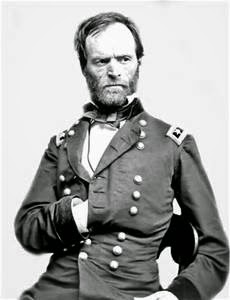
 General William T. Sherman
 

After a bumpy coach ride, General William Tecumseh Sherman, the commanding general of the entire U.S. Army, arrived at Fort Richardson just outside the frontier town of Jacksboro.  Named after a Union general killed at the Battle of Antietam, Fort Richardson was part of a Texas chain of forts established to protect settlers from Native Americans.  From here, U.S. cavalrymen patrolled the vast North Texas prairie for marauding Commanches and Kiowas.  Shortly after his arrival, Sherman began reflecting on the Indian problem and his doubts about its severity.  A number of settlers were complaining about Indian raids, but there was scant evidence that such raids were a regular occurrence.   After all, most of the Comanches and Kiowas were confined to a remote reservation - Fort Sill - located in the southwest corner of the Indian Territory.  Disease and war had reduced their numbers, and the depletion of the buffalo herds kept them dependent on government support.  All of Sherman’s doubts suddenly evaporated with the abrupt appearance of Thomas Brazeal, a teamster with Henry Warren’s supply wagons. 
By the early 1870’s, rampant corruption plagued the U.S. Commission on Indian Affairs.  President Ulysses S. Grant decided the Church could better handle matters with the Native Americans.  Since godly Christians were thought to be incorruptible, military officers were replaced with church officials to manage the Indian reservations.  When confronted by opposing congressmen, Grant replied, “Gentlemen, you have defeated my plan of Indian management; but you will not succeed in your purpose, for I will divide these appointments up among the religious churches, with which you dare not contend.”
The Society of Friends or “Quakers,” a society dedicated to nonviolence, was placed in charge of the most violent Native Americans in the United States.  The Quakers’ goal was simple - convert the nomadic, warrior Comanches and Kiowas into peaceful, sedentary farmers.  They appointed a balding Iowa farmer, Lawrence Tatum, to head the Kiowa-Comanche reservation at Fort Sill.  Considering their ancient warrior customs, converting Comanches and Kiowas into farmers would seem laughable at best.  No fool to Indian ways, Tatum certainly had his doubts.  In describing his new charges, the newly christened “Bald Headed Agent” wrote, “Those in the southwestern part of the territory were still addicted to raiding in Texas, stealing horses and mules, and sometimes committing other depredations, and especially this was the case with the Kiowas and Comanches.  They were probably the worst Indians east of the Rocky Mountains.”  Peaceful, though tough when he had to be, Tatum had the good sense to embrace Fort Sill’s troops in managing the reservation.  Nevertheless, the Kiowas were not about to hitch up a plow horse anytime soon.
Unlike the pragmatic Comanches, the Kiowas were a deeply spiritual people and were quick to rely on the prophecies of a charismatic medicine man or owl prophet.  Such was the case with an obscure Kiowa prophet named Maman-ti or “Skywalker.”  The prophet’s divinations entailed lengthy confinement to a lodge followed by chanting, praying and the unmistakable sound of flapping owl wings.  Afterwards, Maman-ti emerged with a compelling prophecy about the success or failure of an upcoming Kiowa raid.  Shortly after, raiding parties were assembled under the owl prophet’s personal command.  The problem for Tatum and the reservation staff - no one knew him personally or knew what he was up to.
Spring was the season for raiding and Maman-ti was working overtime.  He foresaw the success of a Kiowa attack on the white man’s wagon trains.  To supply its many forts with sustenance, the U.S. Army had to rely on plodding, mule driven wagons - there were no railroads.  Wagon trains, on the desolate prairie, were tempting targets.  Captain Henry Warren, a government freight contractor from Weatherford, supplied the forts of West Texas, including Fort Richardson.  On May 18, 1871, one of his wagon trains, laden with corn, was making its way up the Butterfield Trail toward Fort Richardson.  Several miles further up was a cavalry escorted ambulance with two high ranking passengers inside: General William T. Sherman and General Randolph Marcy, the U.S. Army’s Inspector General.  Both officers were inspecting Texas forts and Fort Richardson was on their list. 
Maman-ti planned his own tour of Texas - a brutal raid that included one hundred fifty Kiowa warriors.  Among the warriors were three of the Kiowa’s fiercest war chiefs: Satanta, Satank and Big Tree.  Satanta’s larger-than-life notoriety spanned decades among Native Americans and white men alike.   The party set out for North Texas and crossed the Red River between present day Vernon and Electra.  To lighten their load, the Kiowas stopped at a place they called “Skunk Headquarters,” a wooded patch with an unusual overabundance of skunks.  Nonessential belongings were dropped off to be guarded by a few young warriors they left behind.  Extra bridles were carried along for any horses they stole and some rode double in hopes of getting a new mount.   
Satanta
 
The Kiowas made their way to Salt Creek Prairie, an open field in Young County between Fort Belknap and Fort Richardson.  The area featured a sandstone hill with a tree-lined base overlooking the Butterfield Trail, an ideal spot for an ambush.  Unfortunately for Henry Warren’s teamsters, they would pass right by it.  During the evening before the Kiowas’ attack, Maman-ti went off alone to communicate with the spirits.  The flapping of owl wings was heard followed by the prophet’s return – he had a vision of two passing wagon parties. The first one was too small - not to be touched, but the second one would give them suitable plunder and scalps.  Sherman’s passing ambulance and cavalry escort would be that first party, thus costing the Kiowas a good chance of killing the highest ranking officer in the U.S. Army.  Warren’s wagon train was next. 
Dozens of whooping Kiowas galloped out of the woods toward the wagons.  Satanta, who learned how to play the bugle in his younger days, signaled the attack with a few crisp notes he borrowed from the U.S. Cavalry.  Like a Hollywood Western, the teamsters circled their wagons to hold off the attack.  Armed with repeating Spencer rifles, the teamsters were able to hold off the Kiowas but eventually fell to their superior numbers.  Seven teamsters were killed, while five, including Thomas Brazeal, managed to escape.  One teamster, Samuel Elliott, was tied to a wagon tongue and slow roasted over an open fire.  The rest were scalped and mutilated.  The Kiowas took forty mules back with them to the Indian Territory.
After Brazeal’s horrifying recollection, Sherman dispatched the 4th U.S. Cavalry to the massacre site. Under one the army’s most effective Indian fighters, Colonel Ranald Mackenzie, the troopers found Indian weapons scattered about the massacre site.  Their design left little doubt as to who was responsible. Sherman’s opinion about the Indian raids changed dramatically.  “I do think the people of Texas have a right to complain,” he wrote, “only their complaints are now against troops who are powerless, but should be against the Department of the Interior’s Bureau of Indian Affairs that feeds and harbors these Indians when their hands are yet red with blood.”  He set off for Fort Sill and a showdown with the Kiowas. 
Sherman arrived at Fort Sill on May 23 and asked an exasperated Tatum about any Indians off the reservation at the time of the massacre.  “The Kiowas and Comanches were completely out of control,” he replied.  “They come and go as they please.”  Surprisingly, the Kiowas were more apt to boast about the raid rather than try to cover their tracks.  Satanta bragged openly that he had led the raid.  With Sherman looking on, Satanta, Satank and Big Tree were arrested and placed in chains.  Maman-ti completely avoided arrest.
The three Kiowa chiefs were placed in a wagon and taken back to Jacksboro for trial.  Along the way, the elderly, melancholy Satank, who carried his dead son’s bones with him in a bag, attempted to stab a guard with a concealed knife.  The old chief was shot dead and his body was dumped unceremoniously off to the side of the road.  Having little regard for their Kiowa prisoners, Satanta and Big Tree were staked to the ground at night while their guards made camp.  
Satanta and Big Tree were sentenced to hang by Jack County Judge Charles Soward.  In an overly agitated state, he ordered Satanta be “hanged until he is dead, dead, dead and God have mercy on his soul.”  Hanging was a form of execution that horrified Native Americans. They feared the tightened rope would block the spirit’s passage after death.  To prevent a Kiowa uprising over the hangings, the sentences were commuted to life imprisonment.  The Kiowa chiefs served two years on a prison chain gang at Huntsville.  In the interest of peace they were paroled in 1874 and returned to Fort Sill. 
Before the end of the decade, continuing Comanche raids led to a military campaign (the Red River War) to force the remaining southern plains Indians on to reservations. The peaceful touch of the Quakers gave way to the clenched fist of the U.S. Army.  Satanta was arrested again for parole violation but he could never adjust to prison life; he took a suicidal leap through a prison hospital window at Huntsville. He was buried in the prison cemetery until he was reburied decades later at Fort Sill.  Big Tree renounced his warrior ways and converted to Christianity.  He became a leading citizen of Anadarko, Oklahoma and a deacon in the Baptist Church.  Maman-ti was taken prisoner during the Red River War and shipped off to Fort Marion in St. Augustine, Florida.  Fort Marion was an old British built fort used to imprison the more troublesome Native Americans.  Among it inmates was the celebrated Apache war chief, Geronimo.  It was there, the owl prophet died from the effects of dysentery.
The terrifying Kiowa warrior “Blue Duck,” in Larry McMurtry’s acclaimed book “Lonesome Dove” is based on Satanta.


Sunday, November 16, 2014

Four Dead in Five Seconds

Marshal Dallas Stoudenmire


Far from Austin, El Paso was a town destined for lawlessness.  Between El Paso and Austin were six hundred miles of arid desert, rocky escarpments, soaring temperatures, rattlesnakes, and Comanches.  Fort Sill, the nearby U.S. Army post, protected residents from the Indians but not the vices brought in by the new railroads.  Like many western boomtowns, El Paso had more than its fair share of saloons, gambling halls and whore houses.  Arguments were often settled with fists and pistols instead of a presiding judge.  Since there was no city government, the local saloon served as a combination courthouse, land office, post office, and city hall.  As a result, the saloonkeeper became a power broker of sorts; he could shape local politics and help appoint friends to high places.
In 1873, El Paso was incorporated and elected its first mayor, a popular saloon owner named Ben Dowell.  Affectionately called "Uncle Ben" by the locals, Dowell was a staunch Secessionist and flew the Confederate flag from his saloon's rooftop; the first one to fly over El Paso.  He was forced to leave town when Union troops occupied El Paso, but later returned after the war.  After Dowell's death, the Manning brothers (Jim, Frank, and Felix "Doc") continued Dowell's business and opened other saloons as well.  The largest of their enterprises was the "Coliseum," a combination saloon and variety theater complete with flirtatious show girls used to solicit drinks.
A close friend of the Manning brothers was the town marshal, George Campbell.  He had the connections, but not the competency for such a role.  His assistant, Bill Johnson, was more suitable for the role of town drunk.  Campbell was the fifth marshal in eight months. His replacement would usher in a new era of law and order for Old El Paso.
Dallas Stoudenmire was a six-foot-two, 185 pound mass of attitude with the rare advantage of having two steady gun hands and two holsters to draw from.  His height made him a big target during the Civil War; he was wounded several times while serving in the 45th Alabama Infantry.  Two bullets would remain inside him for the rest of his life.  Stoudenmire later served three years as a Texas Ranger before becoming El Paso's new marshal.
On his first day, the new marshal revealed his short temper when he stopped by the city jail to get the keys from Bill Johnson.  The former deputy was too drunk to produce them on demand.  Stoudenmire grabbed Johnson by the ankles and held him upside down.  The keys were produced after a vigorous shaking that no doubt left Johnson dizzier than he was before the new marshal arrived.
Border ranches in the 1880's often restocked their herds at the expense of  Mexican ranches across the river.  Rustling was a quick way to get a lot of cattle without the hassle of round ups and negotiated payments.   The problem, however, was the response from the Mexican ranches;  seventy five heavily armed vaqueros rode into El Paso looking for two of their missing comrades and thirty rustled cattle.  The bodies of the missing Mexicans were found near the ranch of Johnny Hale, a well known rancher and cattle rustler.  The two had been looking for the rustled cattle and stumbled upon two of Hale's ranch hands herding them into his pasture.  County Constable Gus Krempkau arrested the ranch hands for murder.  Tensions rose among El Paso's white Americans who didn't like armed Mexicans crossing the border and the Hispanic residents who demanded immediate justice.  Fluent in Spanish, as well as English, Krempkau soothed tempers while a court of inquiry was held and the arrests were made.  The Mexican posse returned home to bury their two friends.  Unfortunately, matters didn't end there.
On the following day, April 14, 1881, Constable Krempkau entered an El Paso saloon to retrieve his rifle and pistol left there the night before.  Johnny Hale and George Campbell followed him in and confronted him over the arrests of Hale's ranch hands.  An intoxicated Hale grabbed one of Campbell's holstered pistols and shot Krempkau.  Campbell and Hale left through the front entrance. 
The shot brought Marshal Stoudenmire up from his chair at the nearby Globe Restaurant.  With both guns drawn, he burst out of the Globe's front doors and began firing at Campbell and Hale.  An innocent bystander named Ochoa was accidently killed from the marshal's fusillade.  Upon looking out from behind an adobe pillar, Hale was killed instantly by a bullet to the forehead.  Before dying, Krempkau managed to shoot Campbell in the wrist and foot.  Stoudenmire finished Campbell off with a shot to the stomach.  The brief but bloody gunfight would pass into legend as the "Four Dead in Five Seconds Gunfight."
Despite the accidental shooting of Ochoa, a coroner's jury found Stoudenmire innocent in the performance of his duties.  Three days later, Campbell's drunken sidekick, Bill Johnson, tried to ambush Stoudenmire as he made his evening rounds.  Fortified with whiskey, Johnson emerged from behind a brick pile bearing a shotgun.  He stumbled backwards and fired both rounds over the head of the marshal; who in turn drew both pistols and dispatched Johnson with a shot to the groin.
Each killing padded Stoudenmire's  growing reputation and made him a living legend.  El Paso's crime rate plummeted as word got around about his ill-tempered  gun hands.  Nevertheless, living legends often become living targets.  The powerful Manning Brothers, close friends and business associates of Hale, Johnson, and Campbell, had it in for him.  The following February brought things to a head.
Like his brother-in-law, Marshal Stoudenmire, restaurant proprietor Samuel "Doc" Cummings, had a consuming dislike of the Mannings and told everyone within earshot that Jim Manning needed to be killed.  During a night of heavy drinking, Cummings spotted Manning and invited him into the Coliseum for a drink, while in the same breath, telling him what a sorry, no count individual he was.  Like most western gunfights, alcohol induced tempers played a major role in what followed.   Pistols were drawn and Cummings was shot dead by Manning and one of the saloon employees.  Because of their overwhelming influence, no El Paso jury would convict a Manning;  Jim Manning was not even charged with Cummings' murder.
A  factional dispute between Stoudenmire supporters and Manning supporters emerged as a result.  To avoid open warfare, the two factions agreed to a truce published in a local newspaper.  Signed by Stoudenmire, the Manning brothers and four witnesses, the truce stated that the two sides would "hereby agree  that we will hereafter meet and pass each other on friendly terms, and that bygones shall be bygones, and that we shall never allude in the future to any past animosities that have existed between us."  The truce was as laughable as it was brief.  Stoudenmire couldn't shake off the death of his brother-in-law; he began to drink heavily and hurl invectives at the Mannings.
On May 29, 1882, Stoudenmire resigned then was immediately appointed U.S. deputy marshal for the Western District of Texas.  His temper and drinking grew worse each passing day; local residents were too afraid to approach him.  The Mannings were smart enough not to directly confront him after he challenged them to a gunfight right outside their saloon.  On September 18, 1882, "Doc" and Jim Manning attempted to call a second truce with the marshal in a neutral spot - a saloon not owned by them.  It didn't work.  After a heated argument, gunfire broke out between both sides.  Stoudenmire was killed by a shot to the head. 
As with the shooting of Samuel Cummings, the Mannings were acquitted by an El Paso jury for the murder of Stoudenmire.  His wife, Isabella, had his body shipped east to Columbus, Texas and buried at Alleyton Cemetery in Colorado County.  Despite his quick temper and drunken tirades, Dallas Stoudenmire is often credited with taming the streets of El Paso.   

Thursday, July 31, 2014

The Long Funeral of Oliver Loving

Charles Goodnight
  
 
Until the turn of the 19th century, the most hazardous undertaking in Texas was driving cattle.  This entailed rounding up wild Longhorn cattle, driving them on horseback for hundreds of miles, and corralling them at a railhead or army fort. Indian attacks, stampeding cattle, rattlesnakes, cougars, bears, wolves, cattle rustlers, and an unpredictable weather pattern added to the trail herder's woes.  Death often meant an impromptu burial out in the middle of nowhere, far beyond the reach of any loved ones.  Life was indeed short for a Texas cowboy.

 
The most noted of all the great cattle drivers and indispensable sources for countless movie and TV scripts were Charles Goodnight and Oliver Loving.  Known as the "King of the Texas Panhandle," Charles Goodnight pioneered the use of cattle drives before the railroads made them obsolete.  Born in 1836, in Macoupin County, Illinois, Goodnight later moved with his family to Milam County, Texas.  He worked as a jockey, a freighter and performed various plantation jobs, including the supervision of slave crews.  He became a scout for the Texas Rangers and discovered the Comanche camp where famed white captive, Cynthia Parker, was camping out with her Comanche husband, Peta Nocona.  During the Civil War, Goodnight served in a Confederate frontier regiment to help ward off Comanche raids.
Goodnight's first big cattle drive originated from Palo Pinto County and headed southwest toward an Indian reservation at Fort Sumner, New Mexico.  The Bosque Redondo Reservation was the brainchild of General James Carleton, who wanted to convert marauding Mescalero Apaches and Navajos into peaceful farmers.  This laughable experiment in forced cultural change was a disaster from the start.  Fights broke out between the Mescaleros and Navajos; longtime bitter rivals now forced to live on the same reservation.  There was no firewood to cook with and the water from the nearby Pecos River was full of alkaline - totally unsuitable to drink.  Unscrupulous army officers and contractors only made matters worse.  Bosque Redondo was later closed after being in operation for only five years.  Goodnight's beef was probably the only thing that kept the Native Americans from starving to death.  
Goodnight developed tactics for driving his immense herds to distant markets.  Because of the loud noise emitted from the cattle drive, Goodnight's trail hands used hand signals to communicate with each other during the drive.  He also invented the chuck wagon to feed his hungry crew and rouse them in the morning with hot coffee. Despite all the innovations, success was only assured by his best friend, Oliver Loving.

 Oliver Loving
Like Goodnight, Loving sought opportunity in Texas.  Born on December 12, 1812, in Hopkins County, Kentucky, he moved to the Republic of Texas with his wife and nine children. As part of the Peter's Colony, he received 640 acres in three Texas counties.  In 1857, he had a thousand acre ranch in Palo Pinto County along with a general store.  With the help of his son, Loving drove his cattle from Texas all the way to Illinois on the Shawnee Trail.  If that wasn't impressive enough, he drove a herd of 1,500 head to a mining camp in Denver, Colorado.  During the Civil War, he drove cattle for the Confederacy; a job for which he was still owed money after the war. 
After teaming up with Loving, Goodnight established the Goodnight-Loving Trail that started from Young County, Texas, headed southwest to the Pecos River, then north to Fort Sumner, Sante Fe and Denver.   Their main obstacles were the Comanches and their business partners, the Comancheros.  As the cattle business increased in New Mexico, so did the business of rustling them.  The Comancheros, native New Mexican's with little regard for Anglo Texans, became the middlemen for the Comanches and illicit cattle contractors in New Mexico and Arizona. 
Leaving the cattle drive, without the support off fellow trail hands, was hazardous to say the least.  During an 1868 cattle drive to Fort Sumner, Loving decided to leave the drive to bid for contracts in Santa Fe.  He promised Goodnight that he would only travel at night to avoid any Comanche war parties.  Accompanied by Bill Wilson, better known as "One-Armed" Bill, they set out in the evening darkness.  Anxious not miss the bidding, Loving made the fatal decision to press on during daylight hours.
Near the Guadalupe Mountains, a party of several hundred Comanches spotted them and gave chase.  After discarding their horses, they set up a defensive perimeter in a ditch near the Pecos River.  Armed with four six guns, a revolving six shot rifle, and a repeating Henry rifle, Loving and Wilson held off the approaching Comanches for hours.  Undeterred, the Comanches shot arrows into the air to rain them down on the surrounded pair.  Both of them hugged the side of the ditch to avoid being hit.  The arrows missed their mark, but not the bullets; Loving was wounded in the wrist and side.  Knowing full well the torture and death that awaited them, Loving decided to stay behind while Wilson attempted to escape the Comanche encirclement and reach Goodnight.  Wilson stripped down to his hat and long underwear, then slipped into the Pecos River at night.  With only one arm, he managed to swim past a Comanche warrior undetected.  Plagued by heat, thirst, malnourishment and bleeding feet, Wilson hiked back to Goodnight's cattle drive. 
For two days, Loving waited for Goodnight.  By now, the Comanches had probably ambushed Goodnight's herd and killed all of the trail hands; he decided to make his own escape.  After getting past the Comanches, he headed toward Fort Sumner.  An oxcart, driven by three Mexicans and an Anglo boy, found him semiconscious by the trail; he was half-dead from fever and loss of blood.  Loving was placed in the cart and taken to the army post at Fort Sumner. 
Goodnight found a crazed "One-Armed" Wilson emerging from a cave.  After discerning Loving’s predicament from Wilson’s senseless babbling, he went after his friend along with six of his crew.  Not finding him, Goodnight rode on to Fort Sumner where he learned of his survival.  Loving's side wound was healing nicely but his arm had developed gangrene.  Loving's arm was amputated, but the gangrene had spread.  For several days, Goodnight sat beside Loving's bed until he died.  Loving's dying wish was to be buried back in Texas.  Goodnight's crew constructed a crude metal casket of empty oil cans for the journey.  Loving's corpse was exhumed from a temporary grave and placed inside.  True to his legendary determination, Goodnight brought him back to Texas for burial at a Weatherford, Texas cemetery.
On July 26, 1870, Goodnight married Molly Dyer, his longtime sweetheart, who taught in a Weatherford schoolhouse.  He continued to drive cattle into New Mexico and Colorado.  In addition, he invested heavily in the development of Pueblo, Colorado and formed Colorado's first stock raisers' association in November, 1871.  Now referred to as Colonel Goodnight, he built a ranch near the Palo Duro Canyon where hostile Comanches once resided.  Affectionately dubbed Home Ranch, his first ranch house was a dugout, using abandoned Comanche lodge poles as rafters.  In 1878, he made his famous treaty with the legendary Comanche chief, Quanah Parker.  He would provide Parker with two beeves each day if the Comanches would leave his herds alone.  With his wife's encouragement, he also started a domestic buffalo herd. Sired by a bull named Old Sikes, he developed the "cattalo" by crossing bison with polled Angus cattle. Buffalo raised on Goodnight’s land would later be used to stock wildlife parks such as Yellowstone National Park.  To educate his ranch hands, he established Goodnight College in 1898.   Goodnight died in Phoenix, Arizona at the age of 93.  He was buried at the Goodnight Community Cemetery near his ranch.
The two best films concerning Texas cattle drives are “Red River” and the TV miniseries “Lonesome Dove.”  John Wayne’s character, Thomas Dunson, in “Red River” is similar in appearance to Oliver Loving.  The mini-series “Lonesome Dove” features two characters based on Charles Goodnight and Oliver loving: Woodrow Call, played by Tommy Lee Jones, and Augustus “Gus” McCrae, played by Robert Duval.  In my opinion, it really doesn’t get any better than this.  During the series, Gus McCrae dies from gangrene after an Indian arrow wounds him in the leg.  In dramatic fashion, Call takes his body back to Texas for burial.  It is doubtful Loving’s burial was as arduous a task.